



AUX vs 3.5 mm: A Practical 2025 Guide for U.S. Audio Engineers and OEM Buyers
-
Key Points
- AUX describes a signal function (line-level audio), not a plug shape.
- 3.5 mm describes a connector size, not the type of signal.
- Many “AUX problems” come from wrong signal levels or plug mismatch.
- Using the right connector, cable, and shielding reduces noise and return claims.
- Jingyi Audio builds OEM-grade connectors for consistent U.S. performance.
Why People Still Mix Up AUX and 3.5 mm
Search “aux vs 3.5 mm” and you’ll find the same question asked thousands of times. The confusion comes from habit. For years, car dashboards and speakers labeled their 3.5 mm jack as AUX IN, so users assumed both terms meant the same thing.
In truth, AUX tells you what the port does—it receives or sends an analog signal at line level.
The 3.5 mm jack just tells you how it connects.For engineers designing dashboards, mixers, or smart speakers, that small mix-up can cause big headaches: distorted sound, buzzing noise, or costly replacements when users plug in the wrong device.
What AUX Means in Plain Language
AUX IN and AUX OUT
AUX stands for auxiliary, or “extra.” In sound systems it refers to a channel that accepts or sends line-level audio—around 1 volt RMS, not powerful enough to drive headphones or speakers directly.
Type
Direction
Typical Use
Signal Level
AUX IN
Receives
Car stereo or powered speaker input
Line-level
AUX OUT
Sends
Mixer or audio interface output
Line-level
If you plug a headphone output (which is already amplified) into an AUX IN, both devices amplify the signal, adding hiss or harsh distortion.
That’s why many technicians suggest keeping the source volume around 70 – 80 % when linking a phone to a car AUX port.The 3.5 mm Plug Explained
A Short Background
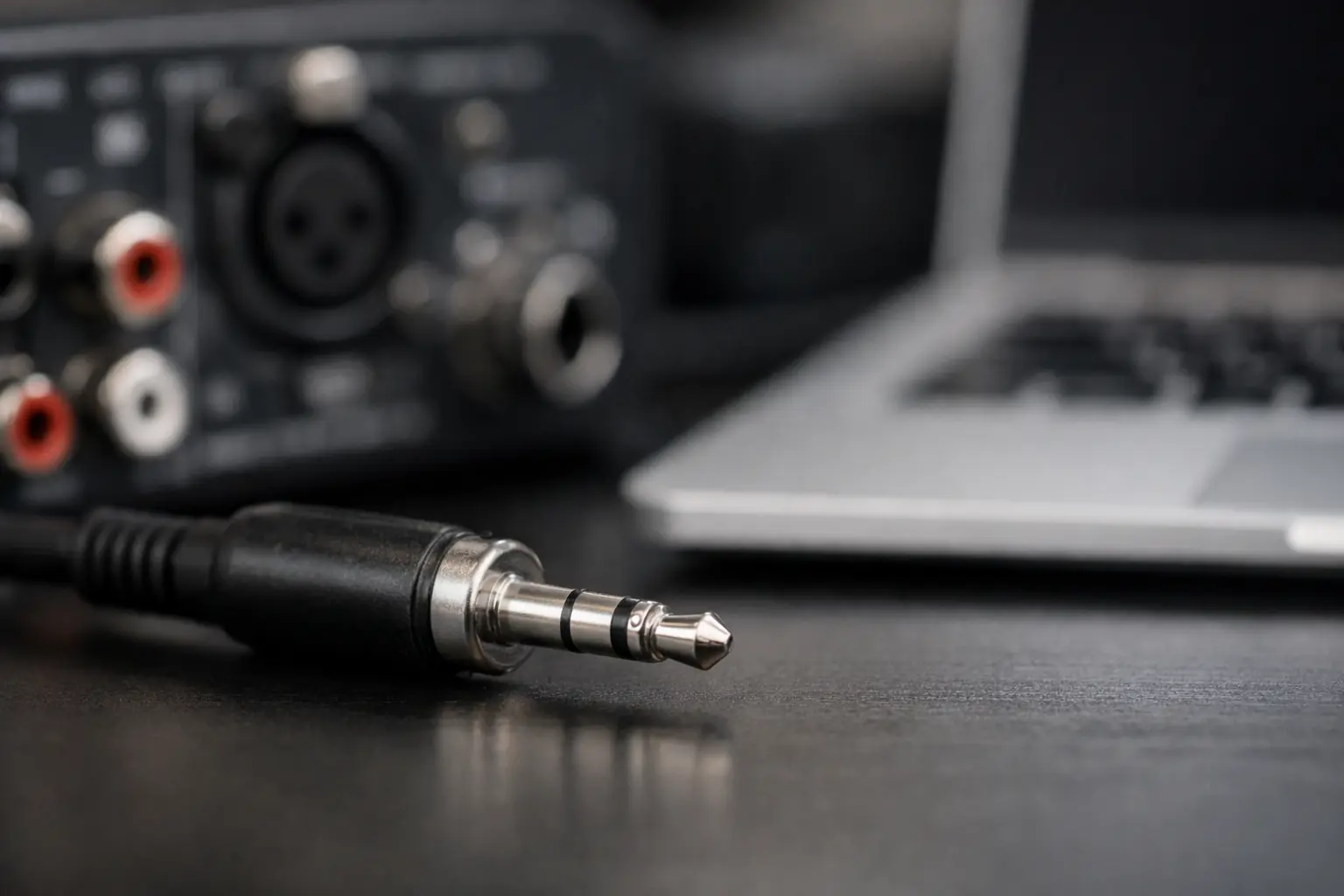
The 3.5 mm jack—sometimes called the mini phone connector—came from the older 6.35 mm version used in telephones and early studio gear. Its smaller size made it ideal for portable music players and laptops.
Even with wireless audio everywhere, the 3.5 mm connector remains common in cars and professional gear because it’s simple, low-latency, and universal.TRS, TRRS and TRRRS — What Those Rings Do
Each ring or sleeve on a plug carries part of the signal:
Plug Type
Contacts
Channels
Common Use
TS
2
Mono
Instruments
TRS
3
Stereo
Headphones, AUX cables
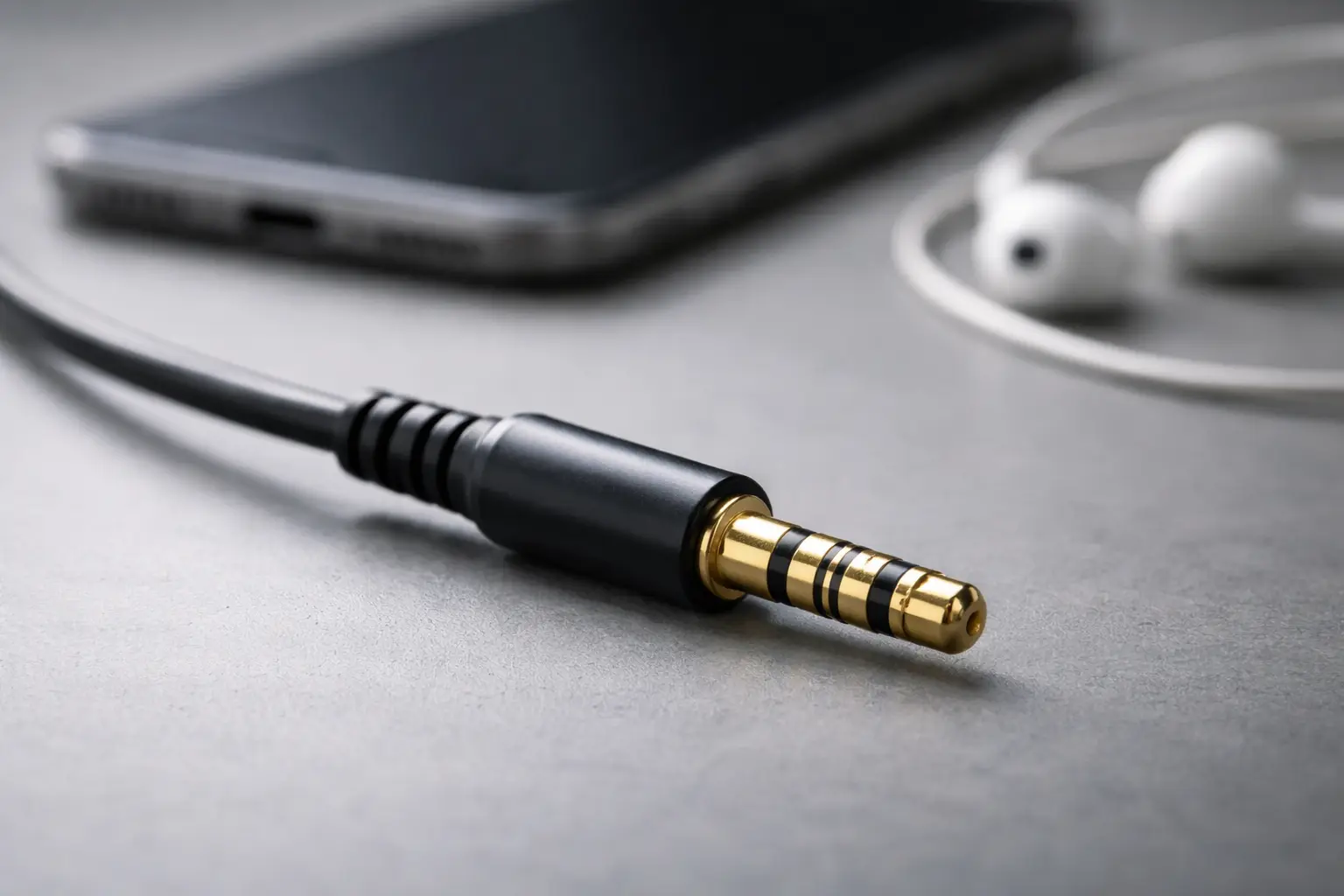
TRRS
4
Stereo + Mic
Headsets, smartphones
TRRRS
5
Balanced stereo
Specialized gear
T = Tip, R = Ring, S = Sleeve.
Stereo cables use TRS. Headsets that carry a mic use TRRS.CTIA vs OMTP Standards
Most U.S. phones follow CTIA, where the last section of the plug (sleeve) is the microphone contact.
Older devices used OMTP, which swapped the mic and ground.
When a CTIA plug meets an OMTP jack, the mic fails or the sound gets thin.
Adapters fix this, but OEM designers can also label ports clearly to stop mix-ups.AUX vs 3.5 mm — Side-by-Side
Property
AUX (Function)
3.5 mm (Connector)
What it defines
Type of signal
Physical size
Signal strength
Line-level (~1 V RMS)
Depends on device
Direction
In / Out
N/A
Typical impedance
10 kΩ – 100 kΩ
Device specific
Used for
Audio input/output
Connection method
So, AUX tells you what, and 3.5 mm tells you how.
Why So Many AUX Cables Sound Bad
Real Issues Seen Online
People on Reddit, Quora, and car-audio forums often report:
- “Static noise when phone charges.”
- “Music only on one side.”
- “Sound cuts when I move the plug.”
Here’s what’s usually happening:
Problem
Likely Cause
What Engineers Should Check
Buzzing or hum
EMI or ground loop
Add better shielding and ground design
One channel only
TRRS plug in TRS jack
Check pin layout or offer adapter
Intermittent sound
Broken solder or weak strain relief
Test for cable fatigue
Distortion
Double amplification
Add input attenuator
Silent mic
CTIA/OMTP mismatch
Confirm standard before shipment
How Connector Quality Changes Everything
Mechanical Strength
Each time a plug slides in or out, metal parts rub together. Cheap materials wear down fast. High-grade connectors, such as those made by Jingyi Audio, last much longer because they use:
- Nickel or gold plating to stop corrosion
- Tight-tolerance housings for solid contact
- Reinforced strain relief to prevent breakage
- Dual shielding (foil + braid) for lower interference
Shielding Against Noise
Badly shielded cables act like antennas. For OEM designs targeting the U.S., it’s smart to meet FCC Part 15 Class B noise limits.
Best practice:- Use braid-over-foil shielding in vehicles or factories.
- Keep signal lines away from 12 V power cables.
- Connect the sleeve to chassis ground securely.
Quick Checklist for OEM Buyers
Requirement
Suggested Value
Reason
Plug type
3.5 mm TRS or TRRS
Match system design
Life cycle
≥ 10 000 insertions
Long-term reliability
Contact resistance
< 50 mΩ
Stable sound
Shielding
Foil + Braid
EMI protection
Certification
ISO 9001 / RoHS / REACH
Required for U.S. imports
Supplier
Proven OEM track record
Why the 3.5 mm Jack Still Matters
USB-C and Bluetooth are everywhere, yet analog connections are still valuable in:
- Cars – for quick plug-and-play use
- Studios – for latency-free monitoring
- Industrial systems – where analog lines act as failsafe inputs
The 3.5 mm jack is simple, cheap, and dependable—qualities that digital adapters can’t fully replace.
U.S. Market Expectations
OEM teams in the U.S. usually ask suppliers for:
- Certifications: FCC, UL, RoHS, REACH
- Consistent quality batches and traceable lots
- Datasheets & drawings with imperial and metric units
- Local support with short response times
Meeting these expectations helps overseas manufacturers build long-term business in North America.
Jingyi Audio — A Partner for OEM-Grade Connectors
Founded in 1992 and based in Ningbo, China, Jingyi Audio designs and manufactures:
- 3.5 mm and 6.35 mm connectors
- XLR and RCA assemblies
- Custom bulk cables and harnesses
With over 15 000 m² of factory space and certified processes, the company focuses on OEM component supply, not consumer retail.
That means each connector can be tailored for life cycle, plating type, and mechanical fit.Instead of selling “AUX cables,” Jingyi Audio provides the parts that let other brands build reliable products.
Common Troubleshooting Scenarios
Symptom
Diagnosis
Field Fix
Low volume
Mic input used instead of AUX IN
Re-route or relabel jack
Loud hum with charger
Ground loop
Ground isolator or improved shield
Only left/right channel
Plug not seated or TRRS mismatch
Use TRS cable
Crackling sound
Oxidized contacts
Replace or clean connector
No signal at all
Broken internal wire
Replace cable assembly
Testing these before shipping avoids expensive returns.
Design Tips for OEM Engineers
- Label Ports Clearly
Mark ports with full specs, for example:
3.5 mm TRS Line Input (Left/Right – 1 V RMS)
- Validate Lifecycle
Run tests for 10 000 insertions, thermal cycling from -20 °C to 70 °C, and vibration if used in cars.
- Choose Proper Plating
- Nickel – good balance of cost and durability
- Gold – best corrosion resistance for coastal or humid regions
- Document Everything
Provide 2D/3D drawings, test reports, and packaging specs compatible with U.S. distributors.
Stories from Real Users
- Car-audio enthusiasts on Reddit found that turning the phone’s volume down to 80 % fixed distortion—proof that double amplification is the real culprit.
- Laptop users noticed their microphone stopped working after using a new headset—again, CTIA vs OMTP mismatch.
- Garage mechanics eliminated engine whine in AUX lines by moving the cable away from power wires and switching to a shielded cord.
These simple adjustments reflect how design details directly influence everyday experiences.
FAQs
- Are AUX and 3.5 mm the same thing?
No. AUX describes a line-level audio path; 3.5 mm describes the connector size. - Can I plug my phone into a car’s AUX port?
Yes. Keep phone volume around 70 – 80 % to avoid distortion. - Why do I hear buzzing when charging my phone?
That’s a ground loop. A well-shielded cable or isolator usually fixes it. - Why does only one side of my headset play?
A TRRS plug doesn’t match a TRS jack. Use a proper adapter. - What should OEM buyers look for in a 3.5 mm connector?
High insertion life, low contact resistance, strong strain relief, and certifications accepted in the U.S.
Closing Thoughts
Understanding AUX vs 3.5 mm isn’t theory—it’s good engineering. AUX defines the signal; 3.5 mm defines the hardware.
When designers match signal levels, choose the right connector type, and use solid materials, the result is simple: clear, noise-free sound that lasts.For OEMs supplying audio systems across the United States, Jingyi Audio offers the parts and technical guidance to make that possible—one reliable connection at a time.
References
- Talomen – What Is AUX? A Complete Guide to 3.5 mm Audio Ports
- My New Microphone – Are AUX Connectors and Headphone Jacks the Same?
- Hollyland – Different Types of Audio Jacks
- Wikipedia – Phone Connector (Audio)
- Crutchfield – 3.5 mm Audio Cables and Adapters Guide