




Balanced vs Unbalanced TRS: A Clear Guide for U.S. OEM Audio Manufacturers
Key Takeaways
- Balanced vs unbalanced TRS cables decide whether your audio stays quiet or picks up hum.
- Balanced TRS uses two opposite signals to cancel noise (common-mode rejection).
- Unbalanced TS cables are simpler but collect interference over long distances.
- Real studio cases show how the wrong cable can ruin a session.
- For U.S. OEM manufacturers, balanced design is the surest way to meet reliability and noise-performance expectations.
Introduction
If you design or source audio products for U.S. OEM markets, the phrase balanced vs unbalanced TRS isn’t just technical trivia—it’s the line between a clean mix and a noisy return shipment.
A studio in Los Angeles or a podcast space in Nashville expects a dead-silent signal chain. When noise creeps in, it often traces back to cable design or wiring mistakes. That’s why experienced OEM builders, such as Jingyi Audio, treat connector architecture and shielding as core engineering, not accessories.
Let’s unpack what “balanced” and “unbalanced” actually mean, how they behave in the real world, and what choices matter most for U.S. manufacturers.
What Balanced vs Unbalanced TRS Really Means

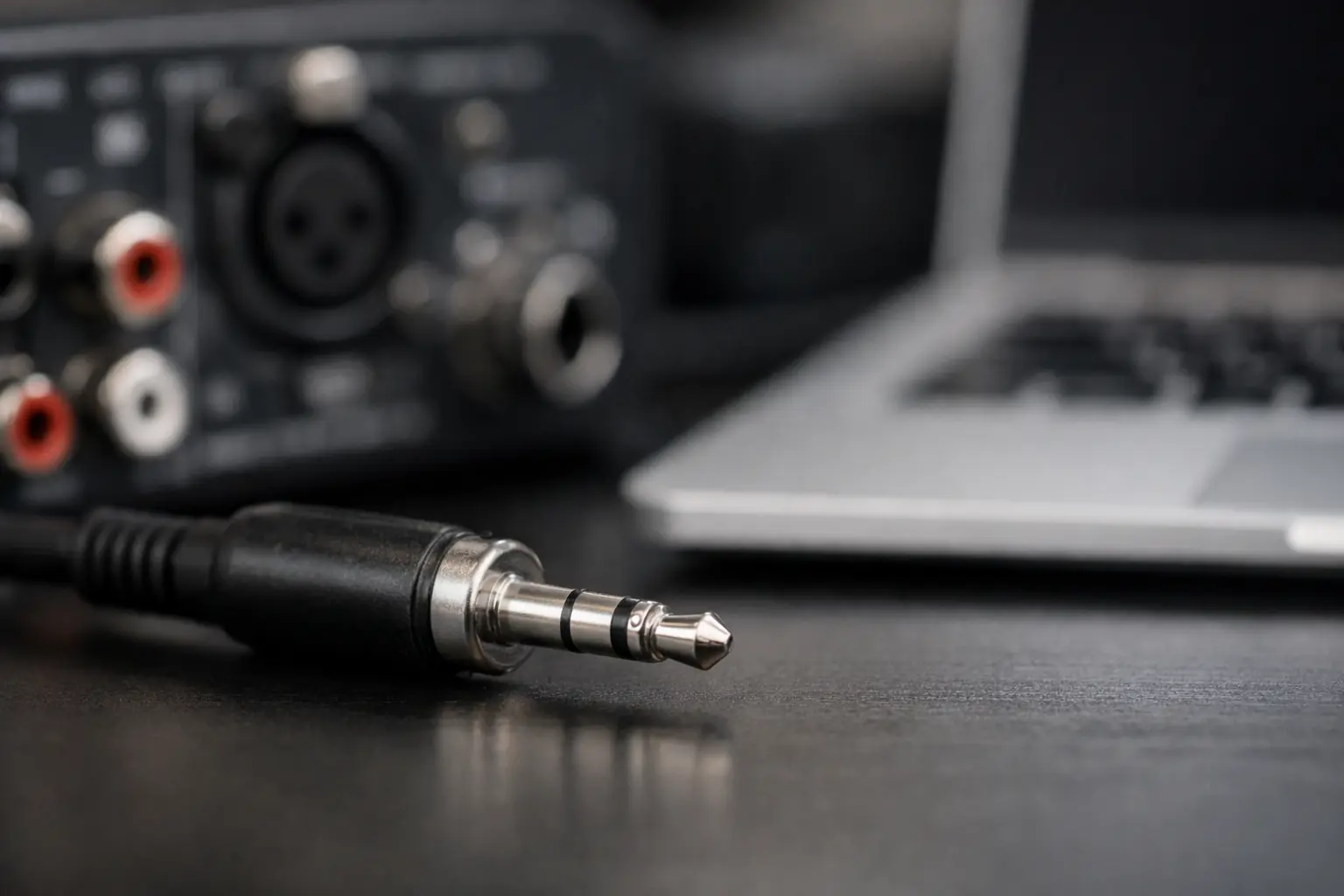
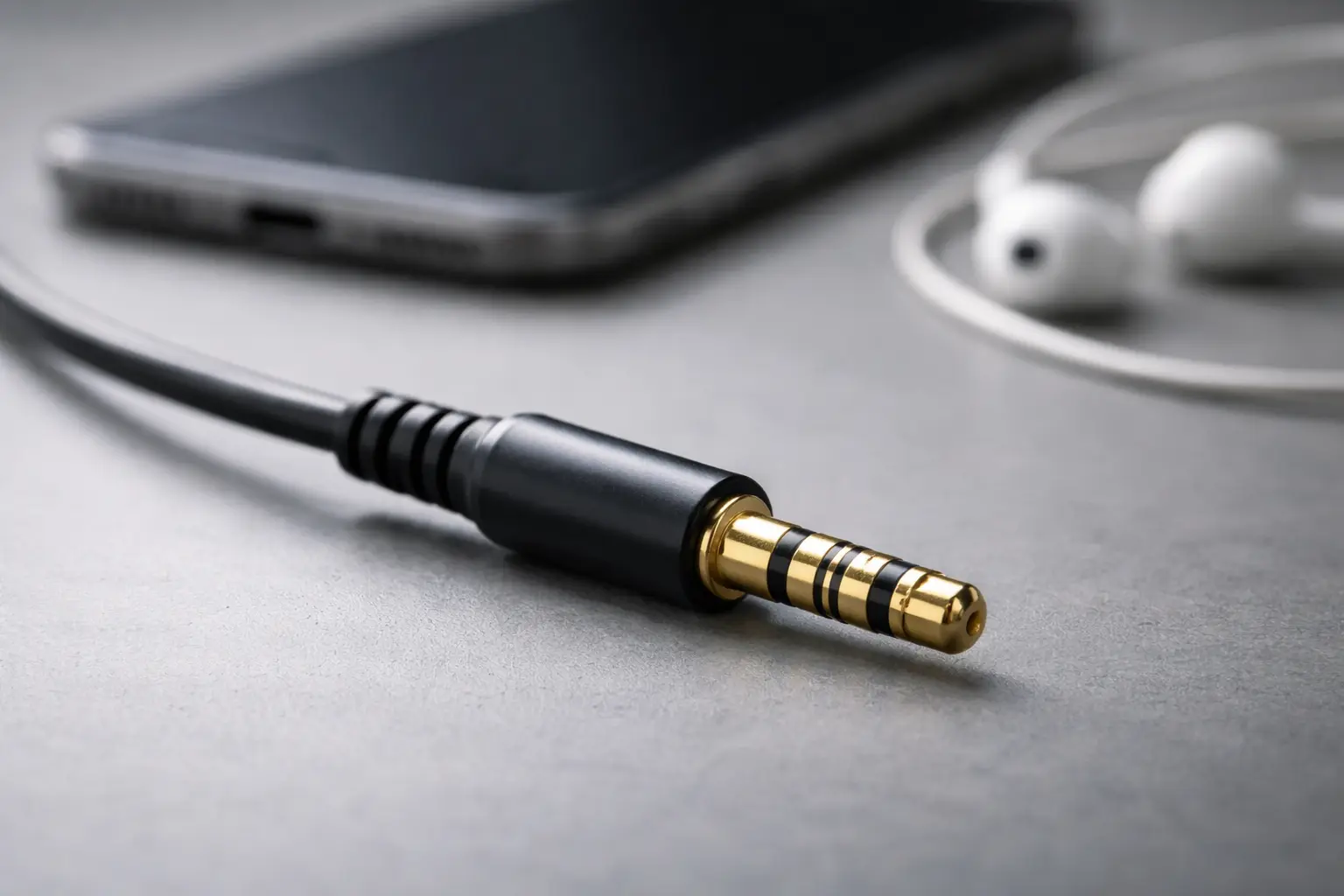
TRS stands for Tip–Ring–Sleeve. These are the three metal contact points on the plug.
A TS plug omits the ring and carries just Tip (signal) and Sleeve (ground).
|
Type |
Conductors |
Typical Use |
Noise Resistance |
|
TS (Unbalanced) |
2 |
Guitars, short runs |
Low |
|
TRS (Balanced) |
3 |
Studio gear, monitors |
High |
Balanced TRS cables carry two mirror-image versions of the same signal—one positive, one inverted. At the input, the device flips one and adds them together. The wanted signal doubles; the noise cancels.
This built-in noise rejection is called common-mode rejection (CMRR).
Unbalanced TS cables, by contrast, send one signal and use the shield as the return path. That shared ground makes them vulnerable to electrical and radio interference.
How Balanced TRS Cables Cancel Noise
Imagine two identical signals leaving your interface—one normal, one inverted. Both lines pick up the same external hum from nearby power cords. When they reach the input, the device flips one of them:
(+Signal + Noise) + (–Signal + Noise) → 2×Signal + (Noise – Noise)
The result is clean sound. That’s the beauty of differential signaling.
OEM Why-It-Matters
For OEM designers, balancing isn’t optional; it’s an assurance policy.
Balanced outputs and inputs reduce returns, lower warranty costs, and help your customers meet UL and FCC Part 15 noise standards.
Jingyi Audio builds TRS connectors and assemblies with precise impedance matching and over 90 % braided + foil shielding—key ingredients for strong CMRR performance in U.S. studios.
Unbalanced TRS (or TS): Simple but Sensitive
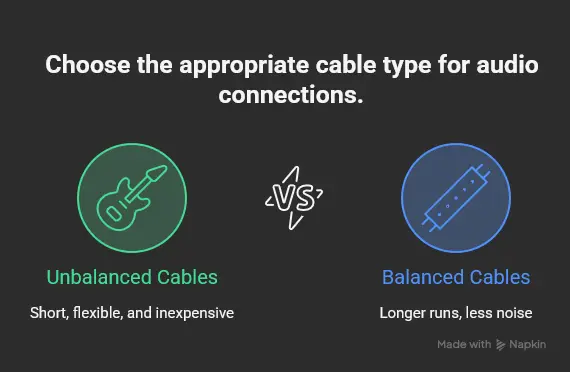
Unbalanced cables dominate the instrument world. They’re short, flexible, and inexpensive—perfect for connecting a guitar to a pedalboard or amp.
But stretch that same cable to 20 feet, and the shield turns into an antenna. The longer the run, the louder the hum.
When Unbalanced is Okay
- Guitar → amp (under 15 ft)
- Small synth → nearby DI box
- Consumer hi-fi connections (RCA)
Beyond that distance, use balanced lines or a DI box.
Real-World Stories from U.S. Studios
Case 1 – The 20-Foot Hum
A California producer ran 20-foot TS cables from his interface to powered monitors.
The result: a persistent 60 Hz hum.
He swapped in balanced TRS cables—silence.
Reason: balanced lines canceled the noise induced by AC mains.
Case 2 – Stereo TRS into Balanced Input
A keyboard player plugged a stereo TRS output into a balanced TRS mixer input.
The mix sounded hollow; vocals and bass vanished.
The mixer treated one side as inverted and subtracted it—classic phase cancellation.
Fix: use a Y-split cable (TRS → 2×TS) to feed left and right into separate channels.
Case 3 – USB Noise from Unbalanced Outputs
A user of an entry-level interface with RCA outs heard “digital chirps” every time he moved his mouse.
Those sounds came from the computer’s USB bus, leaking into the analog stage.
Upgrading to a balanced TRS output interface solved it completely.
OEM Lesson
Each failure came from ignoring cable topology.
By designing products with balanced I/O and clear labeling, OEM manufacturers can prevent most support tickets before they happen.
Stereo TRS vs Balanced TRS – Don’t Mix Them Up
A TRS plug doesn’t always mean a balanced connection.
Some devices use TRS for stereo unbalanced signals (left and right channels), while professional gear uses it for balanced mono.
Quick Check:
- Balanced mono: Tip = Hot ( + ) | Ring = Cold ( – ) | Sleeve = Ground
- Stereo unbalanced: Tip = Left | Ring = Right | Sleeve = Ground
Plugging the wrong one can make your mix sound thin or phasey.
This confusion appears constantly on forums—clear it up on your product pages and spec sheets.
OEM Specifications That Make the Difference
|
Spec |
Target Value |
Purpose |
|
Conductor material |
99.99 % Oxygen-Free Copper (OFC) |
Lower resistance, better CMRR balance |
|
Shield coverage |
≥ 90 % braid + foil |
Blocks RF/EMI in dense studio racks |
|
Capacitance |
≤ 30 pF/ft |
Keeps high frequencies clean |
|
Pull test rating |
≥ 10 kg |
Survives install stress |
|
Fire rating |
UL 94 V-0 |
U.S. compliance for rack gear |
|
Bend cycles |
≥ 5,000 |
Longevity for field use |
Balanced TRS cables built to these specs meet OEM buyer expectations in Los Angeles studios, New York broadcast hubs, and Nashville tour rigs.
OEM RFP Checklist
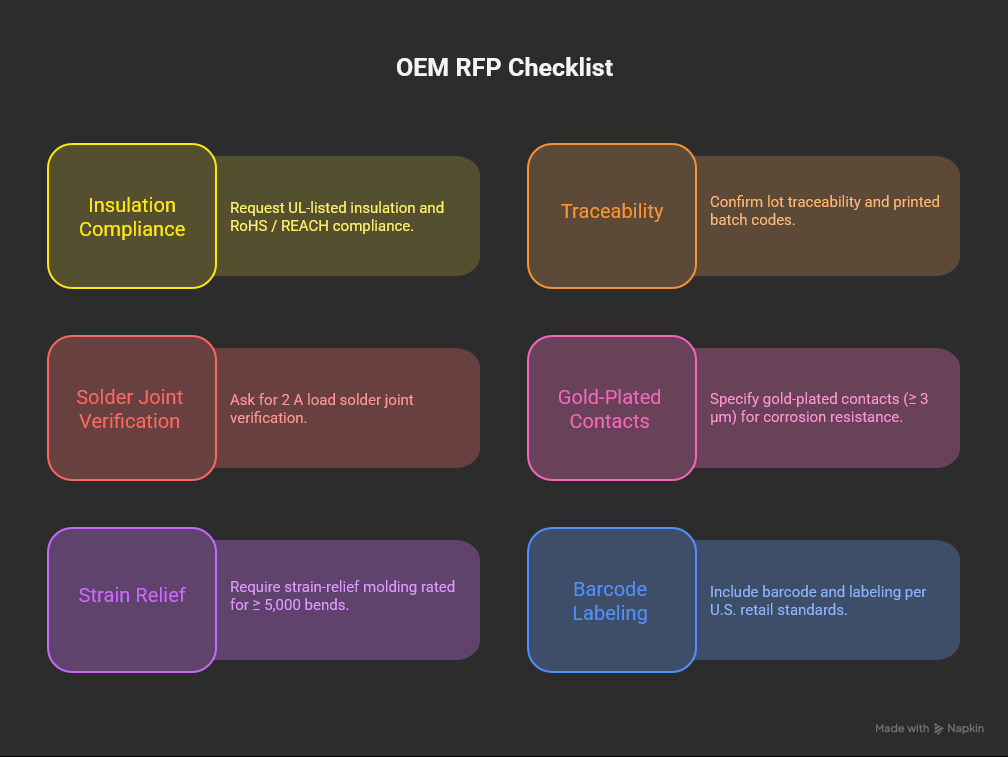
When sourcing or manufacturing balanced TRS lines for U.S. distribution:
- Request UL-listed insulation and RoHS / REACH compliance.
- Confirm lot traceability and printed batch codes.
- Ask for 2 A load solder joint verification.
- Specify gold-plated contacts (≥ 3 µm) for long-term corrosion resistance.
- Require strain-relief molding rated for ≥ 5,000 bends.
- Include barcode and labeling per U.S. retail standards.
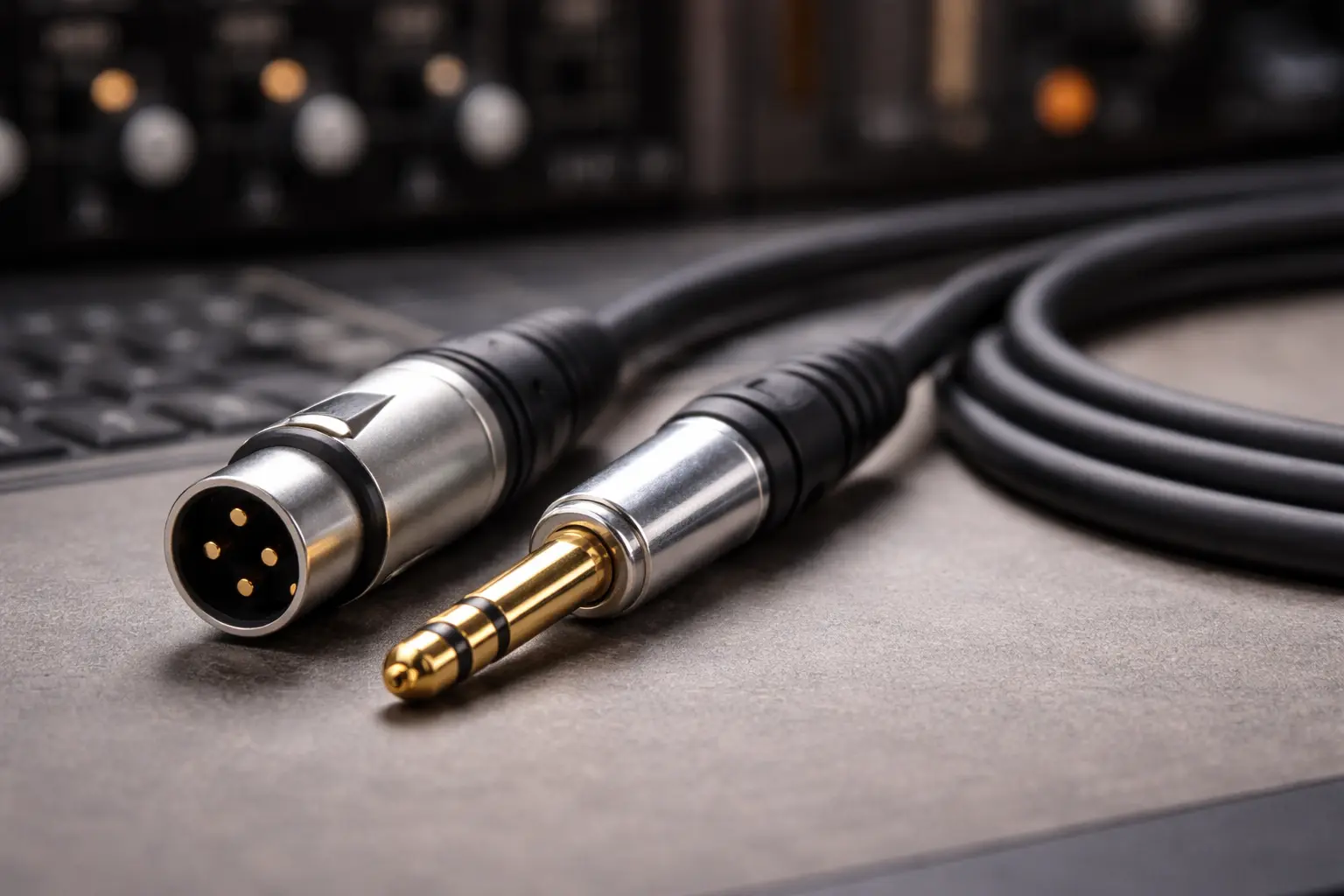
Jingyi Audio meets these through its OEM program, offering TRS–TRS, TRS–XLR, and XLR assemblies customized for American brands.
Decision Tree – Which Cable Do You Need?
1️⃣ Is the run longer than 15 ft (4.5 m)?
→ Use balanced TRS or add a DI box.
2️⃣ Is the source output labeled “Stereo” or “Phones”?
→ Use a Y-split (TRS → 2×TS), not balanced mono.
3️⃣ Are there power supplies or computers near the cable path?
→ Use double-shielded balanced TRS.
4️⃣ Do you hear a low hum (≈ 60 Hz)?
→ Check for ground loops; lift ground or isolate equipment.
Common Connection Mistakes
|
Mistake |
Symptom |
Fix |
|
TS plug in balanced jack |
Weak / noisy signal |
Use TRS balanced cable |
|
Stereo TRS → balanced input |
Thin sound, missing bass |
Use TRS → 2×TS |
|
Ground loop between devices |
Low hum |
Lift ground / balance interconnects |
|
Long unbalanced run |
Buzz / interference |
Convert to balanced with DI box |
Short TS patches (< 3 ft) can work between balanced jacks but expect a 6 dB drop and zero noise rejection.
Balanced Audio Trends in the U.S. OEM Market
- Compact balanced connectors: 3.5 mm TRS and TRRS used in mobile recording.
- Hybrid digital-balanced designs: combined USB and analog paths for podcasting.
- Flexible low-capacitance braided cables: favored for film sets and broadcast trucks.
- Custom OEM looms: pre-wired balanced harnesses for rack integration.
Jingyi Audio supports these by providing small-form balanced assemblies with gold-plated TRS ends, OFC conductors, and multi-layer shielding.
Quick Rules for Studios and Integrators
- Keep unbalanced runs under 15 ft.
- Use balanced TRS for anything longer.
- Separate signal and power lines to avoid EMI.
- Label ports clearly—“BALANCED MONO” vs “STEREO UNBALANCED”.
- Document every connection in installation manuals.
FAQs – Balanced vs Unbalanced TRS
1️⃣ What’s the main difference?
Balanced TRS cables send two opposite signals that cancel noise; unbalanced TS uses one signal and ground, so it picks up interference.
2️⃣ Can I use a TRS cable in an unbalanced output?
Yes, but it won’t create a balanced signal—the device must output balanced audio for that to work.
3️⃣ Why do my speakers hum with unbalanced cables?
They’re catching noise from power lines or lighting. Balanced TRS lines remove it through CMRR.
4️⃣ Does balanced audio sound better?
Not in tone, but it’s cleaner and quieter — especially over long runs.
5️⃣ Are TRS and XLR the same thing?
Both can carry balanced signals; TRS is smaller for line level, XLR is standard for mics.
6️⃣ Where can I source OEM balanced TRS cables?
Jingyi Audio supplies custom balanced TRS and XLR assemblies for U.S. OEM brands and studio integrators.
Final Thoughts
Clean audio isn’t an accident. It comes from balanced design, good materials, and clear documentation.
For OEM and B2B manufacturers, balanced TRS connections turn technical reliability into a marketing advantage.
By partnering with a precision supplier like Jingyi Audio, you get the shielding, materials, and quality control that keep your gear quiet from Los Angeles to New York.
Good sound starts with good connections — and balanced TRS is the quiet choice.
Citations & References
- Focusrite Support – Differences Between Balanced and Unbalanced Audio
🔗 https://support.focusrite.com/hc/en-gb/articles/115005178585-Differences-between-balanced-and-unbalanced-audio - TourGear Designs – What’s the Difference Between TS vs TRS?
🔗 https://www.tourgeardesigns.com/blogs/blog/what-s-the-difference-between-ts-vs-trs - Bax Music Blog – Balanced and Unbalanced Connections (Finally) Explained
🔗 https://www.bax-shop.co.uk/blog/cables/balanced-and-unbalanced-connections-finally-explained - Gearspace Forum – Balanced TRS Cables and Unbalanced Outputs Discussion
🔗 https://gearspace.com/board/connectors-cables-stands-and-accessories/484440-balanced-trs-cables-unbalanced-outs.html - Jingyi Audio – Professional OEM Audio Cable Manufacturer (Official Site)
🔗 https://site_5615465d-0395-48c6-b01f-dc3d38213fc5 - Sweetwater – What’s the Difference Between a TS Cable and a TRS Cable?
🔗 https://www.sweetwater.com/insync/ts-vs-trs-cables/ - Rane Commercial – Sound System Interconnection (Technical Note 110)
🔗 https://www.ranecommercial.com/legacy/note110.html