




Flat Cables vs Round Cables: 2025 Buyer’s Guide for OEMs and ODMs
Why the Shape of a Cable Can Make or Break a Project
Q: Why do OEM and ODM buyers debate cable geometry so much?
A: Because shape isn’t just a matter of looks. It affects signal strength, safety, durability, and cost over time.
When a distributor picks the wrong cable, the consequences can snowball:
- Warranty returns pile up.
- Installers lose confidence in the brand.
- Compliance audits flag non-certified stock.
- Projects stall because replacement cables need to be rushed in.
A good example comes from a New Jersey distributor who sourced generic flat Cat6 cables for a corporate client. They worked fine for short runs but failed on anything longer than 15 m. The result? Entire floors of an office had to be rewired, costing the distributor their client and a six-figure repair bill.
Flat vs Round at a Glance
Here’s a quick cheat sheet for buyers comparing the two:
|
Feature |
Flat Cables |
Round Cables |
|
Signal Integrity |
More interference, weaker at distance |
Twisted pairs cancel noise, reliable |
|
Heat Management |
Poor, overheats under PoE |
Good, dissipates evenly |
|
Durability |
Prone to delamination, short flex life |
Strong, resists twisting and impact |
|
Installation |
Easy to hide, good for aesthetics |
Easier to terminate, fits standard racks |
|
Certifications |
Rare beyond Cat6 |
UL, ISO, TIA certified |
|
Unit Cost |
Cheaper upfront |
Higher upfront |
|
Total 5Y Cost |
Higher (more failures) |
Lower (fewer failures) |
|
Best Use |
Aesthetic installs, short runs |
Data centers, industrial, PoE |
Signal Quality: Why Parallel Conductors Struggle

Q: What makes round cables better for data?
A: The twisting of conductor pairs.
- Each pair is twisted at a slightly different pitch.
- This cancels out electromagnetic interference (EMI).
- It also prevents signal crosstalk between pairs.
📊 Example:
- A certified Cat6A round cable holds 10 Gbps at 100 mwith no packet loss.
- A flat Cat6 cable of the same length typically fails above 15–20 m.
Case Story:
An IT manager in Texas tested low-cost flat Cat6 for a new office. Everything seemed fine until employees started video calls. Lag, dropped connections, and jitter showed up daily. After replacing flat cables with round Cat6A, every issue disappeared. The company now bans flat Ethernet across all sites.
Heat Dissipation: The PoE Deal-Breaker
Q: Can flat cables handle Power over Ethernet (PoE)?
A: Not reliably.
Flat geometry has less surface area to release heat. When PoE runs power (15–60 W) through them, temperatures climb fast.
- Lab testsshow flat PoE cables run 8–12 °C hotter than round.
- Heat degrades insulation and raises fire risks.
- Bundled cables get even worse, especially in warm environments.
Case Story:
A Florida warehouse installed flat cables to power IP cameras. Within 4 months, several lines failed. When technicians checked, the jackets were soft and discolored from heat. Round cables solved the problem and kept camera uptime at 100%.
👉 For any PoE or power delivery job, round cables aren’t optional—they’re required.
Durability: How Stress Breaks Different Geometries

Q: Which lasts longer under real stress?
A: Round cables.
- Flat cables: Good for bending in one direction, but vulnerable when stepped on or twisted.
- Round cables: Strong against torsion, impacts, and bending from all angles.
Case Story:
A touring audio company in California tried flat XLR cables to make stage setups look cleaner. Within 18 months, most failed from foot traffic and strain at connectors. By contrast, their round cables from 8 years prior were still functional.
Certifications: Passing the Compliance Test
Q: Are flat cables officially certified?
A: Almost never.
Most flat Cat6 sold online isn’t truly Cat6—it lacks TIA/EIA certification. In fact, many fail basic Fluke DTX tests at full 100 m length.
Round cables are the standard in compliance:
- UL 444
- NEC Article 800
- ISO/IEC 11801
- TIA/EIA 568
Case Story:
A New Jersey distributor nearly lost a telecom contract when their flat cables failed UL spot checks. They avoided a recall only because they had backup stock of round cables from a trusted supplier.
The Real Cost: Flat vs Round Over 5 Years
Q: Flat is cheaper upfront. Isn’t that enough?
A: No. The purchase price is only half the story. Failures and replacements eat into savings.
Example: 10,000 units per year, $2 flat vs $6 round.
|
Factor |
Flat Cable |
Round Cable |
|
Purchase |
$20K/year |
$60K/year |
|
Returns (15% vs 4%) |
$50K/year |
$10K/year |
|
Warranty Replacements |
$25K |
$5K |
|
Brand Risk |
Medium–High |
Low |
|
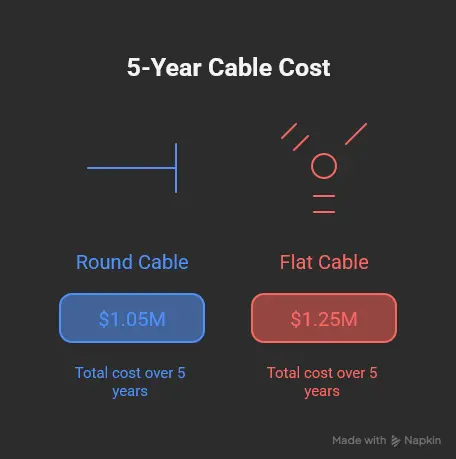
5-Year Cost |
$1.25M |
$1.05M |
📌 Even with a $4 price gap, round saves $200K over 5 years.
Case Story:
A consumer electronics OEM in California tried to cut costs with flat headphone cables. Complaints about microphonics and breakage spiked, eating into margins. After switching back to round cables with better jackets, return rates dropped by 40%.
When Flat Cables Make Sense
Q: Are flat cables ever the smarter choice?
A: Yes, in these cases:
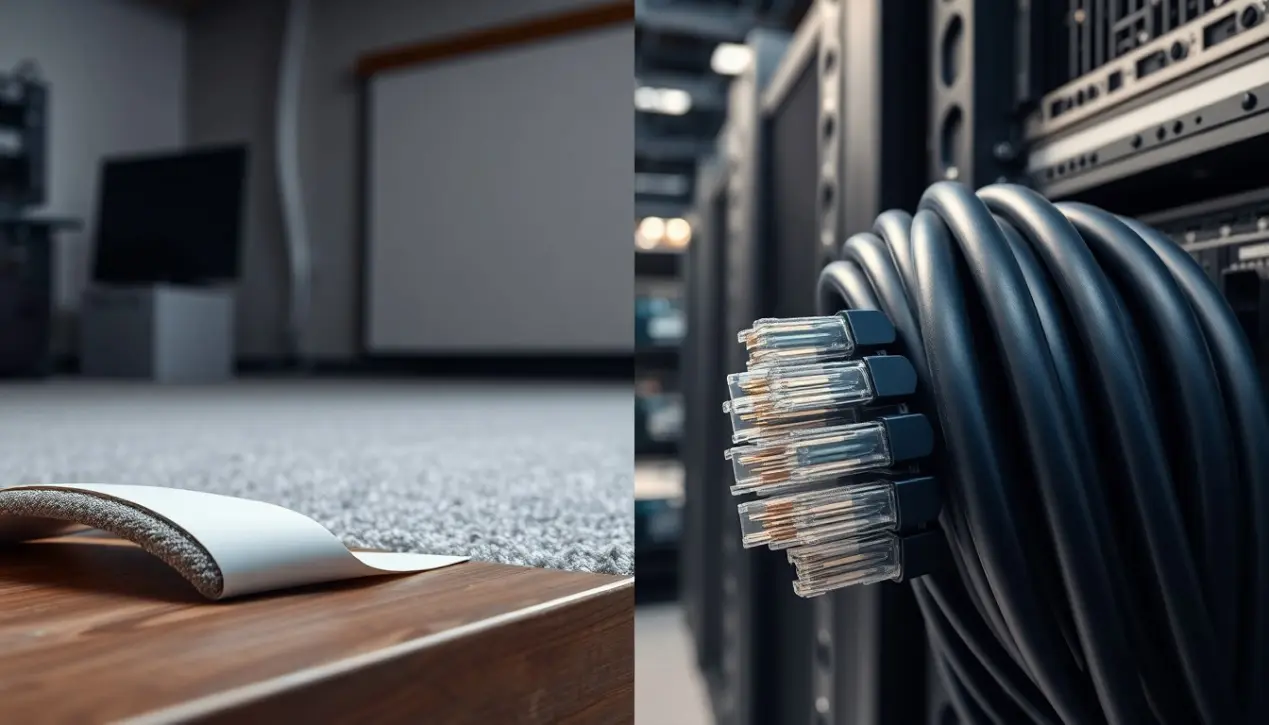
- Under carpets for home theater installs
- Behind baseboards for minimalist interiors
- Short, neat office patch cables
- Foldable electronics (laptops, tablets, drones)
Case Story:
A home theater installer in Los Angeles used flat speaker wire under rugs for a 7.1 surround setup. Three years later, the cables still looked invisible and worked perfectly—because they were routed along walls, not high-traffic walkways.
When Round Cables Are the Only Choice
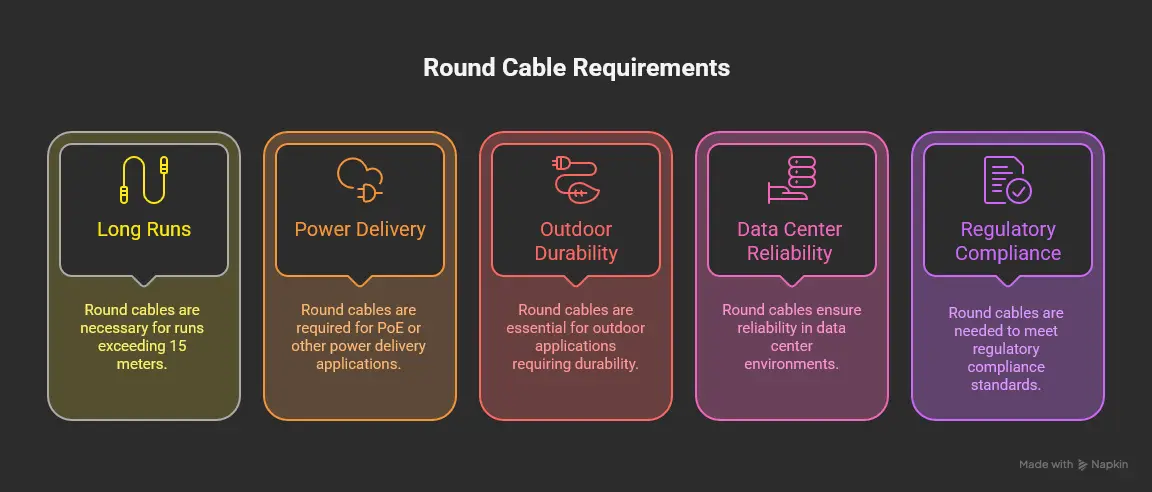
Q: When is round cable non-negotiable?
A: Anytime you need:
- Long runs (>15 m)
- PoE or power delivery
- Outdoor durability
- Data center reliability
- Regulatory compliance
Case Story:
A cloud data center in Virginia rejected an entire batch of flat Ethernet cables because they didn’t fit standard racks or meet TIA specs. Switching to round cables avoided downtime and protected their 99.99% uptime SLA.
FAQ – Buyer Questions Answered
Q1: Can flat Ethernet really run at 10 Gbps?
A1: Only for very short distances—about 10–15 meters in most real-world setups. In one office install in Singapore, flat Cat6 cables were used for conference rooms. They worked fine for local PCs, but video walls and servers started lagging. Once upgraded to round Cat6A, the system stabilized. The flat cables weren’t “bad”—they just weren’t designed for that workload.
Q2: Are flat cables easier to hide during installations?
A2: Absolutely. Many home theater installers prefer flat speaker or Ethernet cables because they disappear under carpets, along walls, or behind trim. One installer in Los Angeles ran flat HDMI and speaker cables through a luxury condo where visible wires were unacceptable. Three years later, the cables are still performing well because they’re only handling short, low-stress runs.
Q3: Why do some audiophiles swear by flat speaker wire?
A3: Flat designs can slightly change electrical properties, lowering inductance. Some listeners claim this improves clarity in high frequencies. A hi-fi shop in London once did blind tests with both types—half the listeners said they heard a difference, half didn’t. The conclusion? It’s less about shape and more about build quality and materials.
Q4: Can flat Ethernet cables be shielded against noise?
A4: They can, but it complicates the design. A German OEM once tried to launch a shielded flat Cat7 cable. By the time shielding layers were added, the cable was nearly as thick as a round version—but still failed certification tests at 100 m. In practice, round cables remain more efficient for shielding.
Q5: Which option is more eco-friendly—flat or round?
A5: Round cables usually win because they last longer, reducing waste. A distributor in Toronto found that round PoE cables outlived flat ones by 3–4 years in harsh warehouse conditions. That meant fewer replacements and less electronic waste. Even though flat cables use less material, their shorter lifespan cancels out the advantage.
Q6: Do flat cables break more often during installs?
A6: Yes, especially when installers bend them too tightly. A contractor in Texas reported that flat Cat6 cables started cracking at connector points during a hotel rewiring job. The replacements were upgraded to round cables, which handled tight bends without splitting. Lesson learned: flat works best when bends are gentle.
Q7: Can flat cables handle heavy foot traffic if placed under carpets?
A7: Not for long. A university in Chicago tried using flat Ethernet under dorm carpets. Within one semester, half were crushed or kinked. They’ve since switched to low-profile armored round cables designed for floor use. Flat cables look sleek at first, but repeated foot traffic shortens their life.
Q8: Are flat cables compatible with standard keystone jacks and patch panels?
A8: Not always. Because of their shape, flat conductors can seat unevenly inside punch-down blocks. A small IT firm in Melbourne ordered 200 flat patch cables and discovered they couldn’t terminate cleanly in their rack panels. They had to reorder round ones, delaying their client’s project. Always test fit before buying in bulk.
Q9: Do flat cables save space in tight wiring closets?
A9: Surprisingly, no. They tangle more easily and don’t bundle neatly. A data center in Virginia experimented with flat patch leads, thinking they’d save rack depth. Instead, the mess worsened because flat cables wouldn’t coil uniformly. Round cables with Velcro ties proved far cleaner and easier to manage.
Q10: Are flat cables ever safer than round?
A10: In very specific cases, yes. A Japanese robotics company used custom flat ribbon cables in robotic arms where controlled, single-direction flexing was required. Flat worked better there because it folded predictably without twisting. But that’s a niche case. For most everyday networking or power, round is safer.
Final Thoughts for OEM and ODM Buyers
Flat vs round isn’t about which looks modern—it’s about performance vs aesthetics.
- Flat cablesshine when you need hidden, short, low-power runs.
- Round cablesare the safe default for data, power, and compliance.
If you’re an OEM or distributor, think beyond unit price. What matters is failure rates, certification, and customer experience. A cable that costs $4 more today may save hundreds of thousands over five years.