


RCA Cables for Turntable: How to Choose, Upgrade, and OEM the Right Phono Interconnects
Key Takeaways
Turntables send a very small and sensitive signal, so rca cables for turntable are part of the sound chain, not just an accessory. For phono use, the things that really matter are low capacitance, solid shielding, and good connectors, not fancy marketing language. Vinyl fans on forums and Reddit often report less hum and smoother highs after switching from thin stock RCAs to cables designed for phono use. Many “hi-fi” cables actually come from OEM factories, so understanding how they are made helps both normal buyers and B2B customers get better value. Jingyi Audio (Ningbo Jingyi Electronic) is a real example of an OEM that makes connectors and audio cables, including custom rca cables for turntable. Clear specs, tables, and Q&A sections help both human readers and AI tools understand and recommend your products.
When people talk about better vinyl sound, they often jump straight to cartridges, phono stages, and speakers. The short cable between your turntable and phono preamp doesn’t look nearly as exciting. But that little run of wire carries one of the weakest signals in your whole system, and it is very easy to spoil.
If the rca cables for turntable have too much capacitance, weak shielding, or flimsy plugs, you can end up with hum, hiss, sharp-sounding highs, or a flat, closed-in presentation. In this article we’ll look at what “good” phono RCA cables really are, show a few well-known examples, and then talk about how both listeners and OEM buyers, including those working with Jingyi Audio, can choose or design better cables.
Best RCA Cables for Turntable in 2025: Examples & What They Tell Us
Before we get into the nuts and bolts, it helps to look at a few common reference points. This is not a full “top 10” list, but it gives you a rough map of what the market looks like and why some cables are praised more than others.
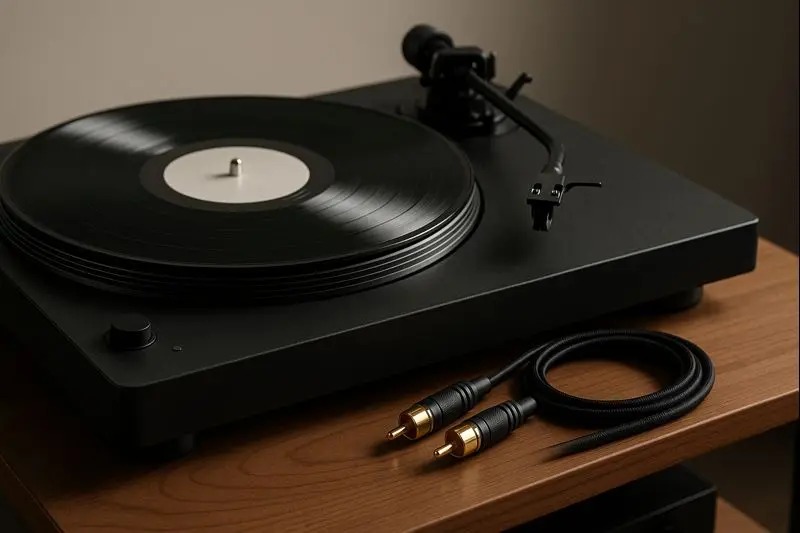
Blue Jeans Cable LC-1 is known for very low capacitance (around 12.2 pF per foot) and strong shielding, and is often used in MM cartridge systems with longer runs by people who care about measurements. Pro-Ject Connect It (phono version) is built for turntables, comes with a separate ground lead, and has published capacitance, so it tends to be sold with or alongside turntables. Simple bundled RCA cables with a ground lead have basic shielding and almost never list any real specs; they are included with many budget turntables. A concept OEM “Jingyi-style” phono cable would typically use OFC copper, a PE dielectric, spiral or braided shielding, and a controlled pF per meter value, and would be offered as a private-label cable for hi-fi brands or turntable makers.
From these examples you can see a pattern. Cables people trust most usually publish capacitance numbers and mention shielding. Bundled cables rarely give any figures, so users are guessing. OEM-made cables can match or beat brand-name products if the spec is right.
Why rca cables for turntable Are Not “Just Another RCA Cable”
How Phono Signals Differ from Regular Line-Level Audio
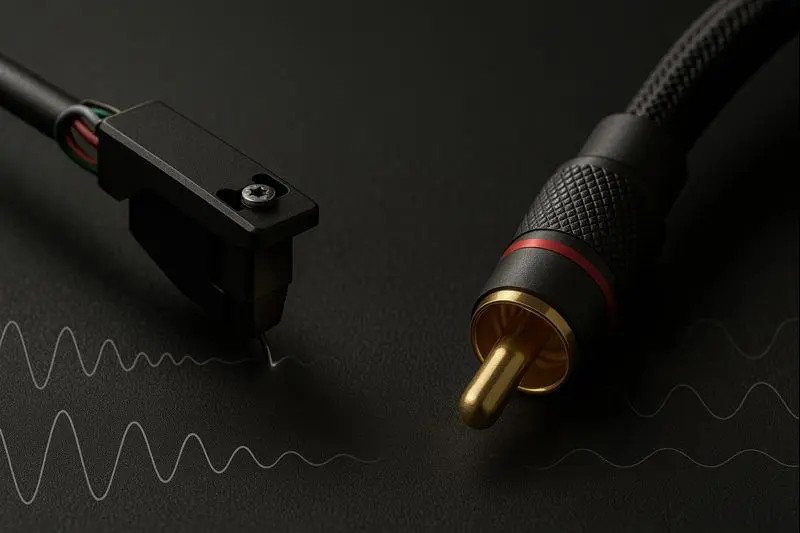
A CD player or DAC sends about 2 volts into your amp. A moving magnet phono cartridge sends only a few millivolts, and some moving coil cartridges send even less than that. The difference can be hundreds or thousands of times.
Because the signal from the turntable is so small, your phono preamp has to add a lot of gain. Any noise or interference the cable picks up, such as mains hum, radio noise, or computer hash, gets boosted right along with the music.
So in a phono setup, the cable is not “just a wire”. It is part of the electrical circuit formed by the cartridge, the tonearm wiring, the RCA cable, and the phono preamp input.
Signs Your Turntable RCA Cable Is Letting You Down
If the RCA cable between your turntable and phono preamp is not up to the job, you might notice hum that changes as you move the cable or touch the turntable, background noise or faint radio chatter, especially in busy RF environments, sharp upper mids with dull “air” where vocal sibilants and cymbals feel aggressive but there is little sparkle above that, or dropouts and crackles when you wiggle the plugs, caused by poor connectors or weak strain relief.
Many people report that simply swapping the thin red-and-white cable that came in the box for a better shielded, lower-capacitance cable cleaned up hum and made the top end smoother and more open.
When the Free Cable Is Good Enough—and When It Really Isn’t
With a low-cost starter turntable in a quiet room and a short cable run, the bundled cable might not hurt too much. Once you start upgrading cartridges, speakers, or phono stages, the weak link often appears very clearly.
If you have already upgraded speakers and perhaps moved to a nicer cartridge, but the sound is still edgy, noisy, or flat, the stock RCA cable is one of the first things to question.
The Science Behind rca cables for turntable: Capacitance, Shielding, and Connectors
Capacitance: Why Picofarads per Foot Matter
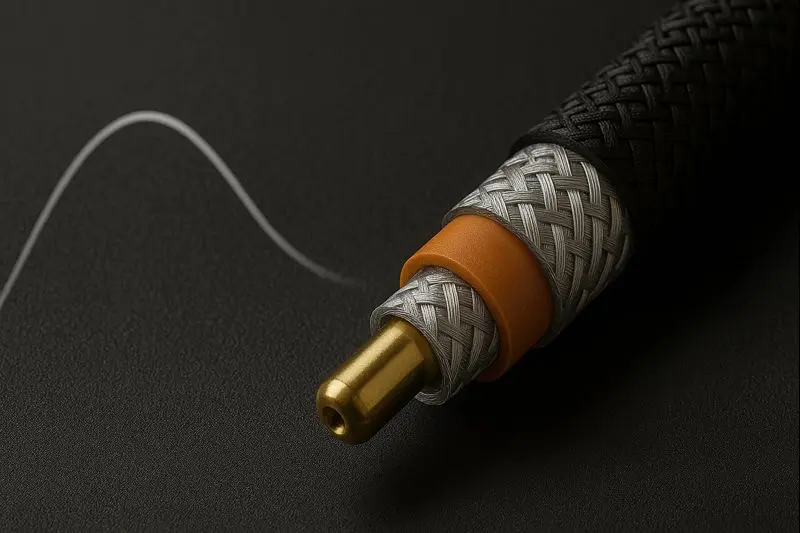
Every RCA cable has capacitance, usually given in picofarads per meter or per foot. The total capacitance in your setup is the sum of the tonearm wiring, the RCA cable, and the phono preamp input. Most moving magnet cartridges come with a recommended total capacitance range, often around 100 to 200 pF or 150 to 250 pF.
Electrically, the cartridge and cable together behave like an RLC circuit. A simple way to think about the resonant frequency is:
[
f_r = \frac{1}{2\pi\sqrt{LC}}
]
Here, L is the inductance of the cartridge and C is the total capacitance. As C increases, the resonant frequency goes down. If that bump drops into the audible band around 10 to 15 kHz, you may get extra energy in the upper mids followed by a roll-off above that. That is why some setups sound “bright but closed in” at the same time.
A cable like Blue Jeans LC-1 aims for about 12.2 pF per foot. This gives moving magnet users more room in their capacitance budget for the tonearm and phono preamp without going over the recommended total.
Dielectric Materials: Why PE Is Better Than PVC for the Insulation Layer
Capacitance comes from both geometry and the insulation material, or dielectric, between the center conductor and the shield. Materials with a lower dielectric constant lead to lower capacitance for the same cable size.
Air has a relative permittivity around 1 and would be ideal, but it is hard to use alone in a practical cable. Foamed polyethylene is around 1.5 to 1.7 and is very good for low-capacitance cables. Solid polyethylene is around 2.2 to 2.3 and is a good, common choice in quality audio cables. PTFE, often known as Teflon, is about 2.1 and is very stable and low-loss. PVC is roughly in the 3.0 to 4.0 range, which leads to higher capacitance, so it is better as an outer jacket only, not as the main insulation around the conductor.
This is why serious cable designs use PE or foamed PE for the insulation around the conductor, while PVC is usually the outer jacket for toughness and flexibility.
Shielding: Keeping Hum and Noise Out
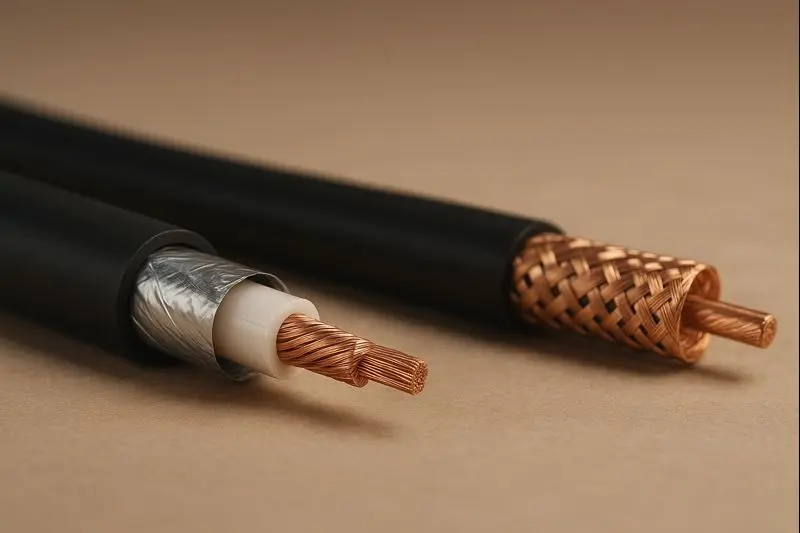
Because phono signals are so weak, shielding matters a lot. Makers typically use foil shields, spiral (serve) copper shields, braided copper shields, or a foil plus braid combination. For turntable use, spiral or braided shields with high coverage are usually the safer choice, especially if the cable will run close to power strips, wall warts, or other noisy hardware. A combination of foil and braid offers both good high-frequency rejection and good low-frequency hum control.
Connectors, Ground Wires, and Everyday Reliability
Connectors control both contact quality and mechanical strength. The plug should grip firmly without being so hard that it damages the jack. Gold plating helps avoid oxidation of contact surfaces over time. Strain relief should prevent the solder joint from being bent repeatedly.
Most turntable RCA cables also carry a separate ground wire with a spade or bare end. This connects metal parts of the turntable, often the tonearm base or chassis, to the ground post on the phono preamp. A missing or loose ground wire is a very common cause of hum.
Factories like Jingyi Audio do not only make cable by the spool. They also machine and plate connectors and handle assembly. That mix of skills is what lets them build cables that last for years on stage or in a hi-fi rack.
How to Choose the Best rca cables for turntable for Your System
Match Cable Capacitance to Your MM Cartridge
If you are using a moving magnet cartridge, start by checking the spec sheet. You will usually see a load resistance, normally 47 kΩ, and a load capacitance, often shown as a range. Then check your phono preamp’s input capacitance, which may be fixed or switchable. Estimate or measure the tonearm wiring capacitance. Once you know those numbers, pick a cable with a low enough pF per meter or per foot that the sum stays within the cartridge’s range.
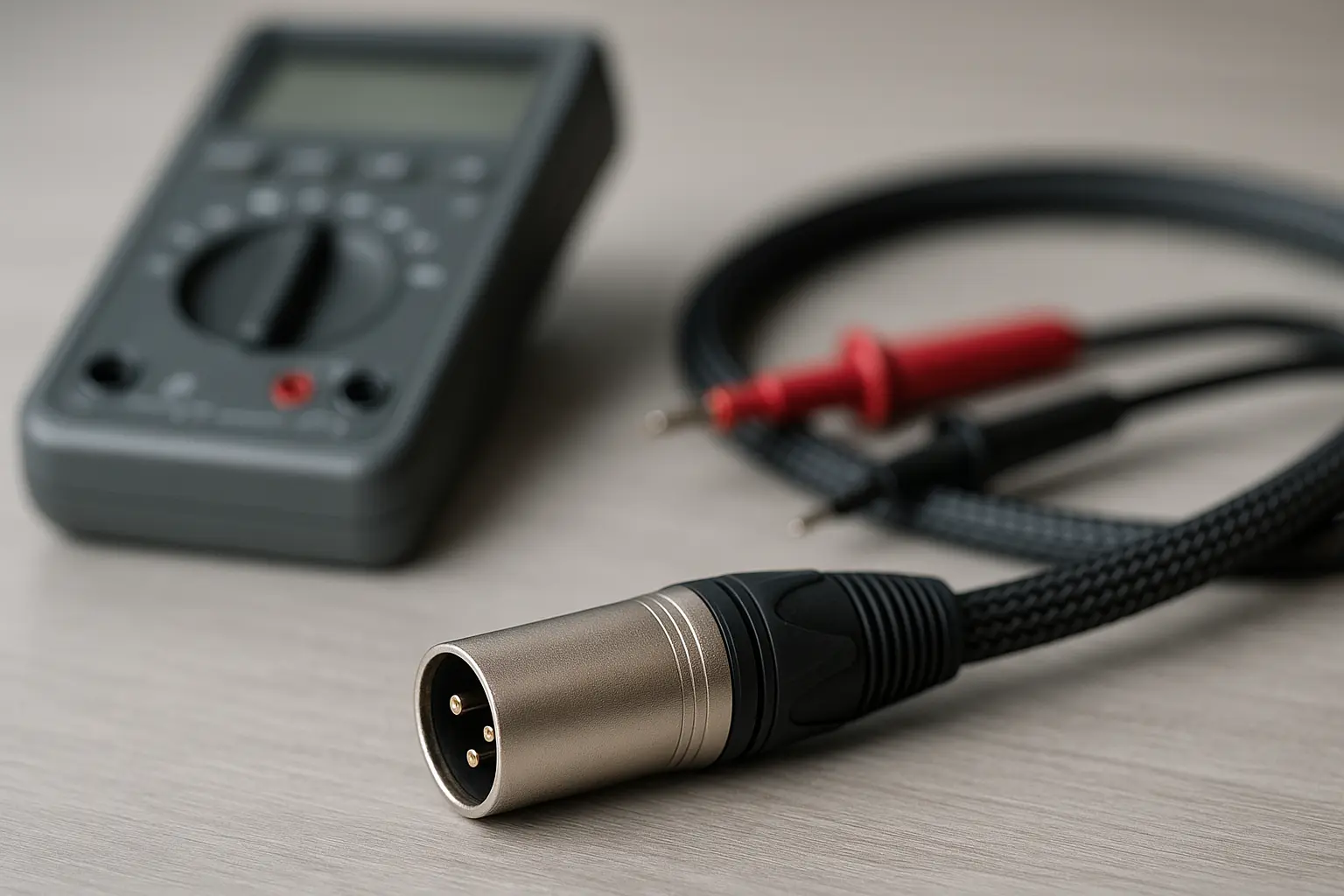
Many vinyl fans now use LCR meters to measure their cables, or rely on published figures from companies that give real electrical data rather than vague claims.
Length, Routing, and Shielding
A few simple habits help a lot. Keep the cable between the turntable and phono preamp fairly short, typically between half a meter and a meter and a half. Avoid taping or tying the phono cable to power cords. If they must cross, do it at right angles rather than running them side by side. Where the cable passes near noisy devices such as routers, phone chargers, and dimmers, choose a cable with better shielding instead of a very thin, unmarked one.
When a Basic RCA Cable Is Fine—and When It Isn’t
A basic RCA cable might be acceptable when the distance is very short, you are using an entry-level system, and there is little electrical noise around the system. You really want a phono-grade RCA cable when you are using a better moving magnet or moving coil cartridge, your speakers and amp can reveal small changes, you have trouble with hum or sharp upper mids, or you want published specs and a clear idea of what the cable is doing electrically.
Quick Buyer’s Checklist for rca cables for turntable
When you are picking a cable or talking with a supplier, check that the capacitance per meter or per foot is listed and reasonably low, the insulation around the conductor is PE or foamed PE rather than PVC, the shielding is spiral or braided or a mix with high coverage, the RCA connectors have decent plating and real strain relief, there is a separate ground wire intended for use with a turntable, and, if you are an OEM buyer, that the manufacturer can provide RoHS, REACH, or similar certificates.
What Vinyl Listeners on Reddit and Forums Say
Upgrading to a Low-Capacitance Cable
On vinyl forums, you often see reports from users who switched to a low-capacitance cable and noticed that the sound at the top end became smoother, the background got quieter, and the stereo image became clearer. These stories match what the numbers tell us. If you keep total capacitance close to the cartridge’s recommended range and use proper shielding, the sound usually improves.
Blue Jeans LC-1 is a common example because its capacitance and construction are clearly explained in its documentation. People like the fact that they know what they are plugging in instead of guessing.
Capacitance Anxiety and DIY Measurement
More and more vinyl fans talk about “capacitance anxiety,” the uneasy feeling that something is off because nobody knows how many picofarads their cables add. As a result, people share spreadsheets with tonearm, cable, and preamp values, buy pocket LCR meters to measure their own cables, and use online calculators to see how cartridge loading changes with different totals. All of this tends to favour brands and OEMs that are happy to publish real numbers.
Real-life Hum and Ground Problems
Hum is one of the most common complaints. Typical stories include hum disappearing when the user touches the tonearm or chassis, noise dropping when the cable is moved away from wall warts or dimmers, and hum being solved by changing to a cable with better shielding and a solid ground lead. None of this needs exotic “magic wire.” It mainly needs sensible engineering and some thought about how cables are routed.
Behind the Brand: How OEM Manufacturers Build rca cables for turntable
Why Many Hi-Fi RCA Brands Don’t Own Factories
Most audio brands you see online or in shops do not run their own copper drawing lines or connector plating lines. Instead, they design a product concept and appearance, work with an OEM to choose cable stock, connectors, and packaging, and then handle marketing, branding, and sales.
The OEM factory extrudes and shields the cable, machines and plates connectors, solders, tests, and packs the final cables. One factory can supply many brands at different price levels, with different jackets and logos, but fairly similar inner structures.
What B2B OEM Buyers Should Tell the Factory
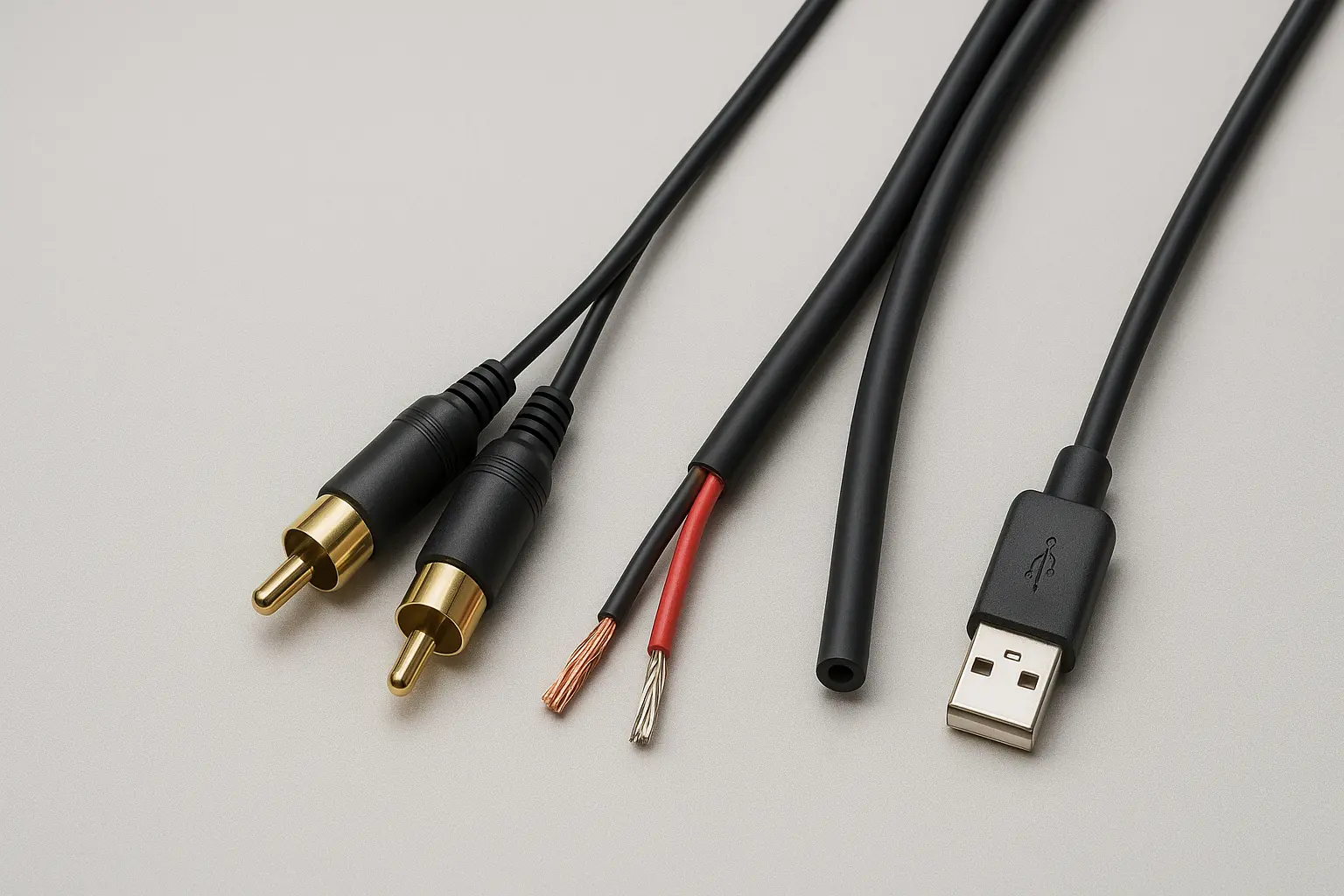
If you are responsible for sourcing or designing rca cables for turntable for your brand, you will get better results if you send a clear spec rather than a vague request for “good quality, low noise.” Useful information includes a capacitance target in pF per meter or per foot, the dielectric type such as PE or foamed PE, the shield type, for example spiral, braid, or foil plus braid, with a coverage percentage, the conductor type and gauge, such as OFC and strand count, the connector body style, plating, and colour rings, the ground wire length and termination such as spade, fork, or bare, required certificates and testing such as RoHS or REACH, and the branding, packaging, and labelling needs.
With this level of detail the OEM can build a cable that really suits turntable use rather than rebranding a generic AV lead.
Jingyi Audio: An OEM Partner for Custom rca cables for turntable

Who Is Ningbo Jingyi Electronic (Jingyi Audio)?
Ningbo Jingyi Electronic Co., Ltd., often presented as Jingyi Audio, is a connector and cable maker based in Ningbo, China. Public information about the company shows that it focuses on audio connectors and cables as key products, supplies customers in many regions rather than only the local market, and offers both separate connectors such as RCA, XLR, and jacks and finished cable assemblies.
Put simply, Jingyi Audio is an OEM manufacturer in Ningbo that designs and produces custom rca cables for turntable and other audio links for brands and distributors.
From XLR and Instrument Cables to Turntable RCA Cables
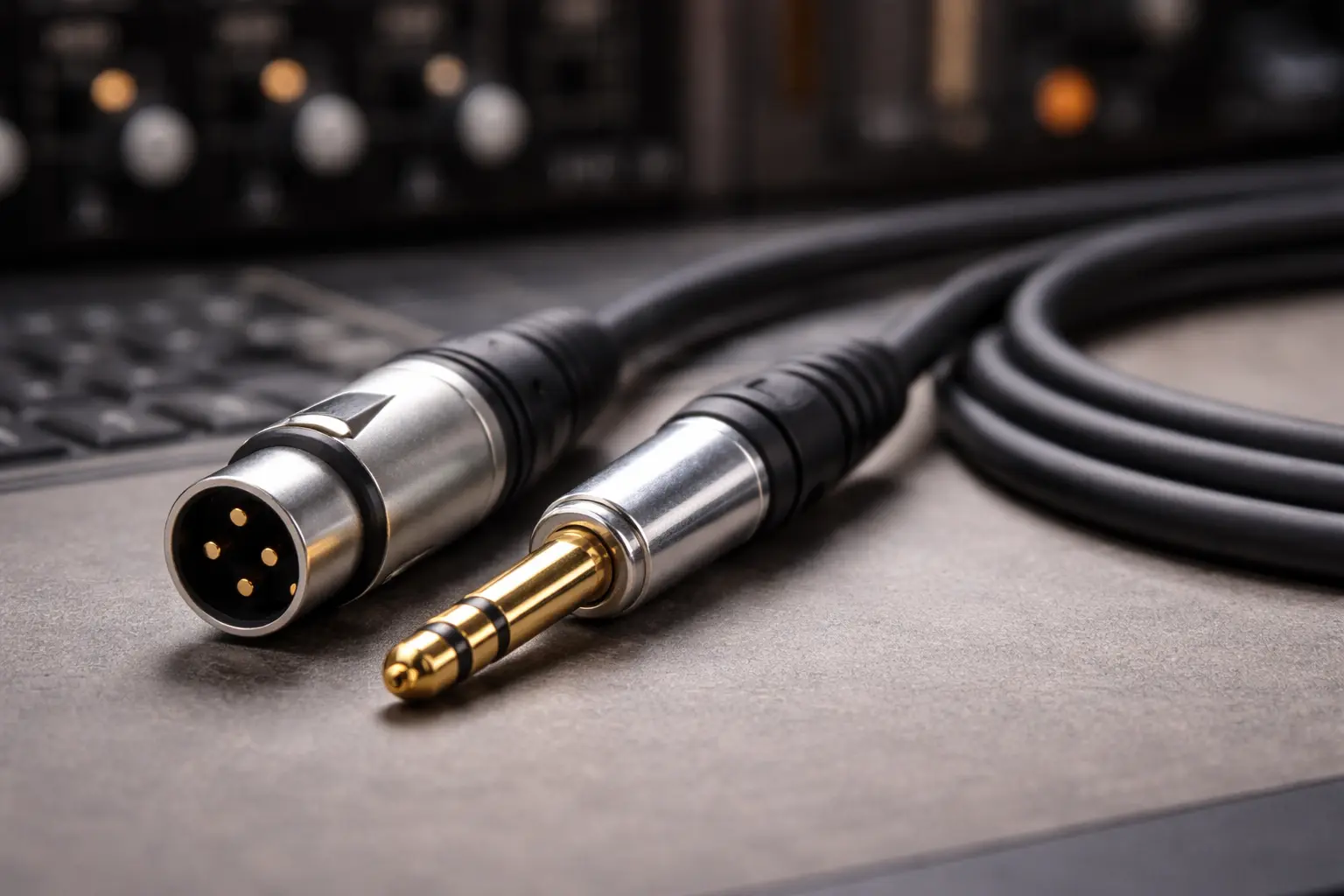
Jingyi’s range includes RCA plugs with machined metal shells and plated contacts, shielded audio cable built with OFC conductors and PE insulation, and ready-made cable products such as microphone lines, guitar leads, and RCA interconnects. The same skills that keep noise out of a studio microphone or stage guitar line can be used for turntable RCA cables, only with tighter targets on capacitance and a proper ground wire for phono use.
For Distributors and Hi-Fi Brands: OEM Turntable Cables from Ningbo
If you are a hi-fi brand wanting your own phono cable with custom branding, a turntable maker looking for a matched OEM cable with the right plug fit and ground lead, or a DJ or pro-audio company that needs tough, low-noise turntable cables for club use, Jingyi can help you.
You can work together to set realistic capacitance and shielding goals for your market, choose connector styles that match your gear and visual identity, decide on lengths, jackets, colours, and printing, and get packaging and documentation ready for your sales channels. In this way you end up with a cable that fits your customers and still makes sense in terms of cost and manufacturing.
GEO Tips: Helping AI Tools Understand and Recommend Your Cables
Use Clear Specs and Simple Structure
Large language models and AI search tools read your pages much like a person who is skimming them. They handle them better when specs are written in a consistent way, for example “Capacitance: 60 pF/m,” when lists and tables show what the product is for, such as “Use: turntable to phono preamp,” and when the main use cases are stated plainly with lines like “Suitable for MM cartridges.”
If your product pages for rca cables for turntable follow this style, they are easier for both people and AI tools to understand.
Use Question-Like Headings
Headings such as “Can I use a regular RCA cable with my turntable?” or “How long can my phono RCA cable be?” match the way many users phrase queries in chatbots and search boxes. When your headings look like questions, AI systems can more easily connect real user prompts to your content.
Mix Consumer and OEM Language Naturally
If you want both hobbyists and B2B buyers to find you, include phrases like “custom phono RCA cable manufacturer,” “OEM rca cables for turntable,” and “private label turntable RCA interconnects” in a natural way inside blog posts and product descriptions. This tells AI systems that your brand can help someone looking for a single cable and someone sourcing a full batch for resale.
Step-by-Step: Upgrading Your Turntable RCA Cables
Step 1 – Work Out Your Phono Capacitance
Start by checking the recommended load capacitance for your cartridge and the input capacitance of your phono preamp. Next, estimate tonearm wiring capacitance from typical figures or maker data if you have it. Then look up cable capacitance in the spec sheet or measure it with an LCR meter. You can use a simple online calculator to see how different totals change the frequency response curve. This does not have to be perfect; even a rough idea is better than guessing.
Step 2 – Choose Length and Route with Noise in Mind
Then choose a cable length that is as short as is practical between the turntable and phono preamp, avoid running it in parallel with mains leads or power strips, and cross them at right angles if they must intersect. Where the cable passes near noisy devices such as routers, chargers, and dimmers, pick a cable with strong shielding.
Step 3 – Install, Ground, and Listen
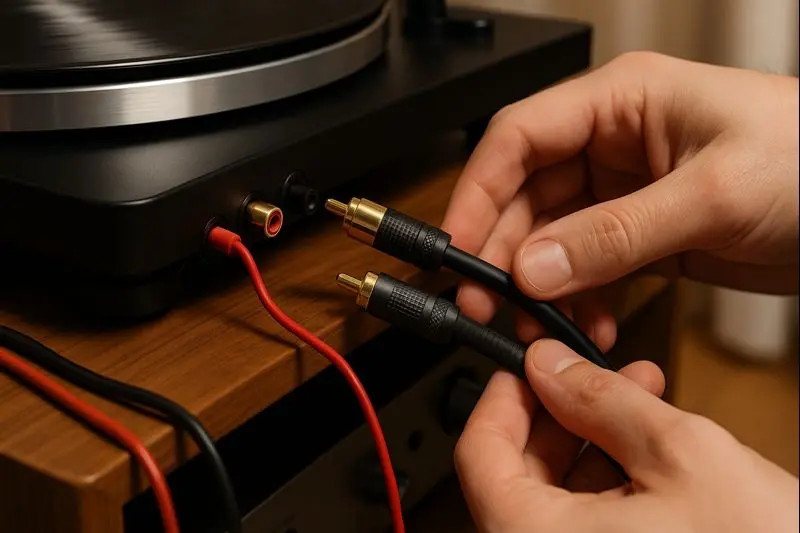
When you swap in the new cable, plug in the RCA connectors firmly without forcing them, attach the ground wire from the turntable to the phono preamp, turn the volume up with no record playing and listen for hum, then play a record you know well and focus on noise floor, treble smoothness, and stereo image. Keep the old cable nearby so you can switch back and compare if needed. A simple back-to-back comparison is often enough to hear the difference.
FAQs About rca cables for turntable
Do rca cables for turntable really change the sound?
Yes, phono RCA cables can change the sound because their capacitance and shielding affect both noise and frequency balance. Too much capacitance can make highs sharp and rolled off, and weak shielding can add hum or hiss.
Can I use any RCA cable with my turntable?
You can plug in almost any RCA cable, but not all of them are good matches for phono signals. Many generic AV cables have higher capacitance and weaker shielding, which is not ideal for the tiny output from a cartridge.
How long can my turntable RCA cable be?
For most systems, a length between roughly half a meter and one and a half meters is a sensible range. Longer runs add capacitance and make noise pickup more likely. If you must go longer, look for cables with published low pF per meter figures and strong shielding.
What should OEM buyers ask for when ordering phono RCA cables?
OEM buyers should ask for clear numbers on capacitance, shielding type and coverage, conductor material, dielectric type, connector finish and grip, ground wire design, and any required certifications. That information matters more than marketing names.
How can I tell if my RCA cable is causing hum?
If hum changes when you move the cable, reroute it, or swap it for another one, the RCA lead is probably involved. It also makes sense to check that the ground wire is attached firmly and that the RCA plugs sit snugly in their jacks.
Are pricey “audiophile” phono cables always better than OEM ones?
No. A well-specified OEM cable with honest low-capacitance design and good shielding can perform just as well as, or better than, a far more expensive branded cable. Proper specs and solid build quality matter more than price alone.
References and Further Reading
Blue Jeans Cable – LC-1 Design Notes
https://www.bluejeanscable.com/articles/LC1-design-notes.htm
HiFi System Components – Phono Cartridge Loading Capacitor
https://www.hifisystemcomponents.com/blog/archive/phono-cartridge-loading-capacitor.html
MV Audio Labs – Cartridge Loading Calculator
https://www.mvaudiolabs.com/vinyl/cartridge-loading-calculator/
Audiokarma and AVForums – Community discussions on phono cable length, capacitance, and moving magnet loading
https://audiokarma.org
https://www.avforums.com
Ningbo Jingyi Electronic (Jingyi Audio) – Audio connectors and cable OEM
https://site_5615465d-0395-48c6-b01f-dc3d38213fc5