

Shielded vs Unshielded Ethernet Cable: The Definitive U.S. OEM/ODM Buyer’s Guide for Reliable Network Performance

1.Introduction: Why This Choice Matters for U.S. B2B Buyers
For American OEM and B2B integrators, choosing between shielded and unshielded Ethernet cable isn’t a minor technical detail—it’s a decision that impacts signal reliability, compliance, cost, and overall product quality.
In the U.S. market, as Ethernet speeds increase and 10-Gigabit networks become the new standard, engineers and purchasing managers must balance shielding performance with installation practicality. Misunderstanding grounding or overusing shielding can create hidden problems later in the field.
This guide breaks down the science, cost factors, and sourcing strategies that U.S. buyers need to make the right call—backed by the OEM/ODM manufacturing experience of JINGYI Audio, a trusted partner since 1992.
2.Technical Fundamentals: Understanding UTP and Shielding Design
What Is Unshielded Twisted Pair (UTP)? How Does It Reduce Noise?
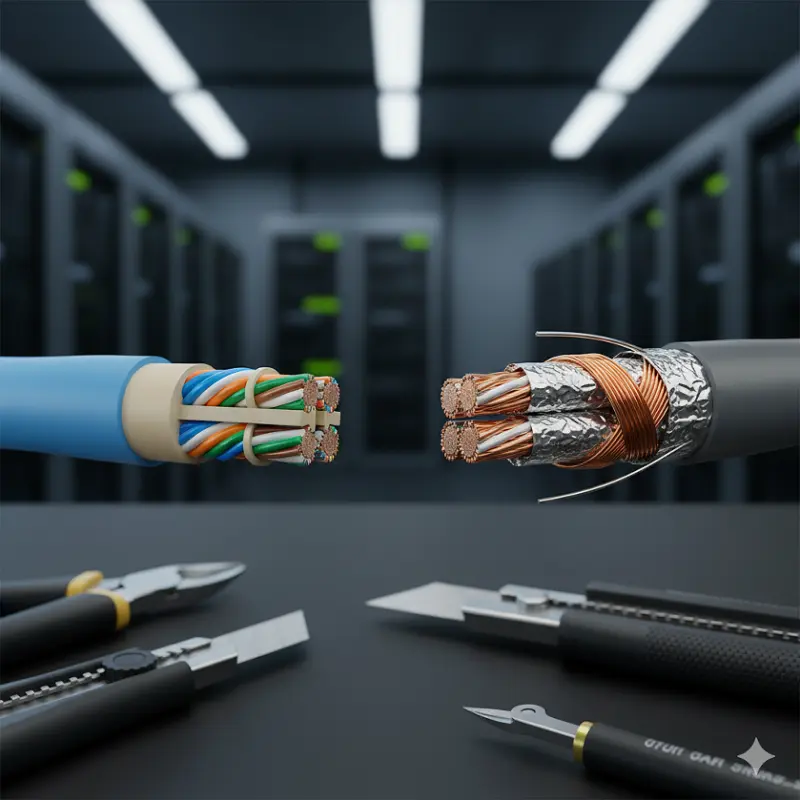
Unshielded Twisted Pair (UTP) cables rely on differential signaling and pair twisting to cancel electromagnetic interference (EMI). Each twisted pair carries equal and opposite currents, and when noise hits both conductors equally, it cancels itself out.
Higher categories like Cat6A may include a central spline or cross separator that reduces crosstalk between pairs. This simple mechanical structure provides excellent noise immunity for most U.S. office and residential installations—without requiring any special grounding.
Understanding Shielding Types: F/UTP, S/FTP, and SF/UTP
Shielded cables add extra protection layers around the twisted pairs:
• F/UTP: Foil shield around all pairs
• S/UTP: Braided screen around all pairs
• S/FTP: Braided screen plus individual foil shields on each pair
• SF/UTP: Both foil and braid wrapping all pairs
These structures protect against external EMI and alien crosstalk, especially in dense cable bundles or environments with high electrical noise.
Why Heavier Shielding Is Needed for Cat6A and Cat8
In higher-speed categories such as Cat6A and Cat8, data signals are more sensitive to interference. Shielding becomes essential to prevent alien crosstalk and ensure stability in high-density environments like server rooms or industrial control panels.
However, the benefit comes with trade-offs: more expensive materials, reduced flexibility, and strict grounding requirements.
3.The Shielding Paradox: Grounding and Installation Risks
Why Improper Grounding Can Cause Failure
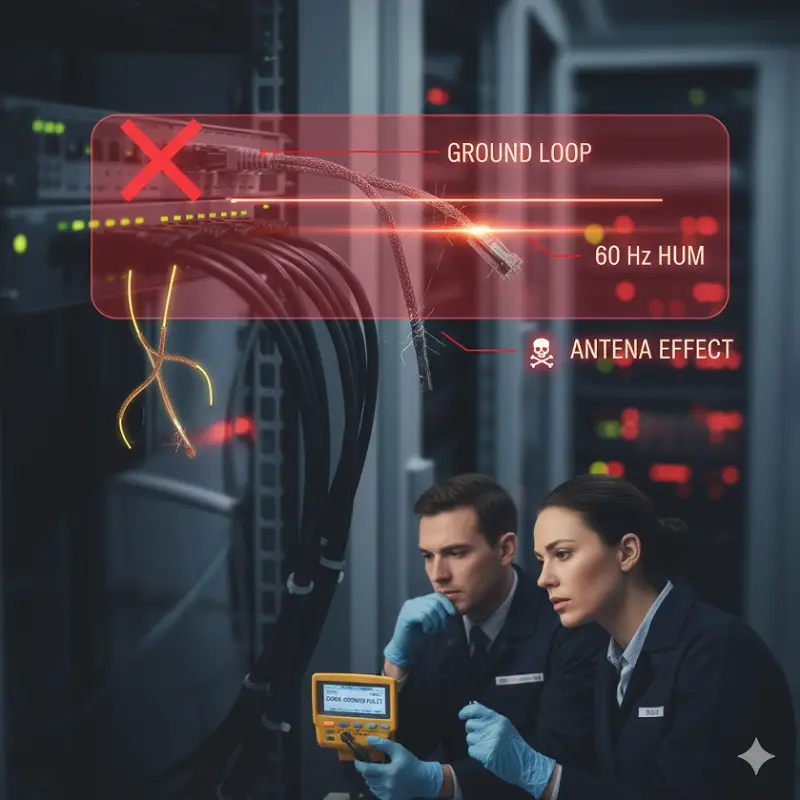
Shielding is effective only when it’s correctly grounded. Without a proper low-impedance path to earth, the shield can become an antenna—amplifying interference instead of blocking it.
Inconsistent grounding practices are among the most common causes of performance issues in shielded installations across the U.S. Even small mistakes in bonding or connector assembly can introduce unpredictable noise and data errors.
Ground Loops and the 60 Hz Hum Problem
A ground loop occurs when a cable connects two devices with different ground potentials. The shield then carries unwanted current, creating low-frequency hum or data corruption.
To avoid this, engineers should follow single-point grounding practices—bonding the shield at one end only. Grounding both ends may seem safer, but it often creates hidden current paths that degrade signal integrity.
When to Use Fiber Instead of Shielded Copper
For connections between buildings, shielded copper is generally not recommended. Each building has its own ground reference, and even minor voltage differences can induce damaging current flow through the cable shield.
In such cases, fiber optic cable is the best option. It provides total electrical isolation, eliminates ground loops, and offers immunity to lightning and surge interference. JINGYI Audio often advises U.S. system designers to switch to fiber for inter-building links to ensure long-term reliability.
4.Application Decision Matrix: Matching Cable Type to Environment
High-EMI and Industrial Environments
Factories, automation lines, and medical facilities produce strong electromagnetic fields from motors, drives, and radio equipment. In these areas, shielded Ethernet cable (S/FTP) is essential for stable signal transmission and compliance with EMI standards.
Shielded cables prevent external noise from entering data lines, ensuring reliable communication for mission-critical systems and 10 Gbps or higher-speed networks.
Offices, Residential, and Low-EMI Environments
In offices, commercial spaces, and homes across the U.S., unshielded cables (UTP) remain the best option. They’re more flexible, easier to install, and less sensitive to grounding errors.
Unless the environment includes strong EMI sources, UTP Cat6 or Cat6A can achieve full rated performance while keeping costs low. For most small business or residential networks, unshielded designs are more practical and easier to certify under U.S. electrical codes.
5.Total Cost of Ownership (TCO): Looking Beyond Cable Price
Material and Hardware Cost Differences
Shielded Ethernet cables cost 20–40% more than unshielded cables due to additional foil, braid, and drain wire materials. They also require shielded connectors and modular jacks, which raise per-unit installation cost.
UTP cables, by contrast, use standard connectors and simpler tooling—ideal for high-volume OEM production where efficiency and cost control are priorities.
Labor, Termination, and Testing Time
Shielded systems take more time to terminate correctly. Each connector must ensure both mechanical bonding and electrical continuity to ground. This increases labor time and demands trained technicians.
Testing shield integrity, grounding resistance, and continuity adds additional steps, which in turn raises project cost and lead time.
Procurement Considerations for U.S. OEM/ODM Buyers
When sourcing Ethernet cables for OEM or integration projects, U.S. buyers typically evaluate:
• Conductor quality(pure copper vs. CCA)
• Shielding uniformityand braid coverage
• Certifications(UL, ETL, CE)
• Packaging, labeling, and customization options
• Supply chain reliability and delivery time
JINGYI Audio meets these needs through advanced manufacturing, rigorous quality control, and export facilities that ensure short lead times to North America.
6.JINGYI Audio: Reliable OEM/ODM Partner for High-Performance U.S. Networks
Why U.S. OEMs and Integrators Choose JINGYI Audio
For over 30 years, JINGYI Audio has partnered with system integrators and network equipment brands to produce high-performance, custom Ethernet cable assemblies. Its OEM/ODM expertise covers every stage—from copper conductor extrusion to shielding fabrication and precision connector termination.
Whether for professional audio, industrial automation, or data networking, JINGYI provides dependable cable assemblies optimized for signal integrity and long-term reliability.
Core Engineering Advantages
|
Feature |
Description |
OEM/ODM Benefit |
|
OFC 99.99% Copper Conductors |
Ensures low resistance and minimal signal loss |
Reliable 10 Gbps and PoE performance |
|
Precision Shielding Technology |
Uniform braid and foil construction |
Superior EMI rejection and consistency |
|
U.S.-Compliant Quality Standards |
Meets UL / ETL / CE certifications |
Simplifies U.S. market entry |
|
Flexible Manufacturing in Thailand |
Efficient production and logistics |
Shorter lead times and lower shipping cost |
|
Custom OEM/ODM Services |
Branding, labeling, and packaging options |
Tailored solutions for integrators and distributors |
7.Decision Framework: When to Choose Shielded or Unshielded
|
Application Environment |
Recommended Type |
Key Reason |
|
Industrial / Factory Floor |
S/FTP Shielded |
Protects data from high EMI levels |
|
Data Center / Dense Rack |
F/FTP or S/FTP |
Prevents alien crosstalk and signal errors |
|
Office / Residential |
UTP Unshielded |
Simple installation, low risk of grounding issues |
|
Inter-Building Links |
Fiber Optic Cable |
Complete electrical isolation and lightning safety |
Guideline:
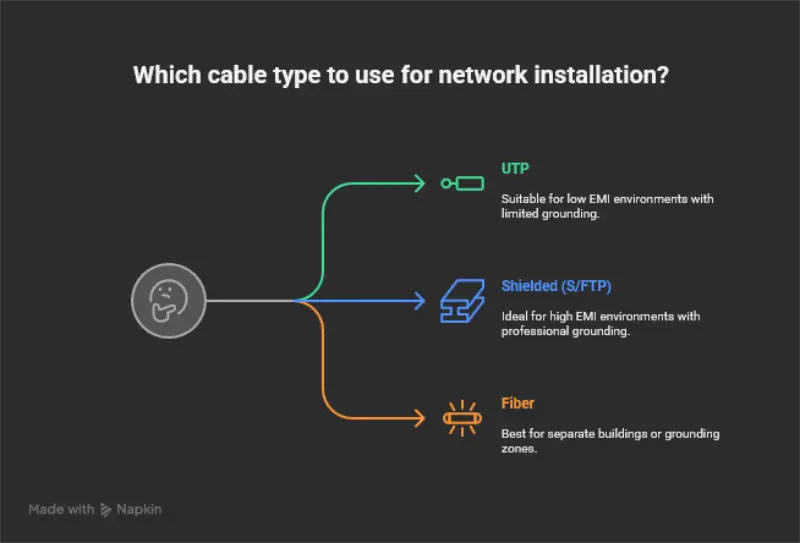
• Use UTPwhere EMI is low and grounding control is limited.
• Use Shielded (S/FTP)only where EMI is measurable and professional grounding is guaranteed.
• Use Fiberwhenever buildings or grounding zones are separate.
8. FAQ: Answers for U.S. OEM and B2B Procurement Teams
Q1: Does a shielded cable improve network speed?
No. Shielding doesn’t increase bandwidth. It helps maintain stable data transfer by blocking interference in noisy environments.
Q2: What’s the most common mistake in shielded installations?
Improper grounding. Without a solid ground path, shields can introduce rather than eliminate interference.
Q3: Is unshielded Cat6A suitable for industrial use?
It can work if cabling is routed far from power lines or motors. Otherwise, S/FTP is the safer, noise-resistant option.
Q4: Why does JINGYI Audio use OFC copper?
OFC 99.99% copper delivers the lowest resistance and best conductivity, ensuring clean data transfer and efficient PoE power delivery.
Q5: Can JINGYI provide OEM/ODM Ethernet cables certified for the U.S. market?
Yes. JINGYI supports custom labeling, UL/ETL certification assistance, and product variations built for American integrators.
Q6: What are the typical lead times and MOQs?
Lead time averages 4–6 weeks depending on customization. MOQs are flexible—from pilot runs to full-scale production for distributors.
9.Conclusion: Balancing Performance, Cost, and Reliability
The debate of shielded vs unshielded Ethernet cable isn’t about which is “better”—it’s about choosing what’s right for your environment and project goals.
For most offices and homes, UTP offers the best balance of cost and simplicity. For industrial and high-density data systems, S/FTP ensures clean transmission where interference threatens performance.
When you need precision manufacturing, certification readiness, and true OEM/ODM flexibility, JINGYI Audio is your trusted partner. With decades of engineering experience and a focus on quality, JINGYI helps U.S. buyers build networks that perform flawlessly.
👉 Ready to customize your Ethernet solution?
Visit site_5615465d-0395-48c6-b01f-dc3d38213fc5 to connect with JINGYI’s OEM/ODM team today.
Citations
1.JINGYI Audio – Company Overview & Product Portfolio: Professional Audio Connectivity Solutions Since 1992.
https://site_5615465d-0395-48c6-b01f-dc3d38213fc5/oem-odm
2.National Electrical Code (NEC) – Article 250: Grounding and Bonding Standards for U.S. Electrical Installations.
https://www.nfpa.org/NEC
3.IEEE Standards Association – Guidelines for Shielded Twisted Pair Cabling in Industrial Environments.
https://standards.ieee.org
4.Telecommunications Industry Association (TIA) – TIA/EIA-568 Structured Cabling Standards.
https://www.tiaonline.org
5.JINGYI Audio R&D Division – Internal Engineering Data and Technical Reports on Cable Shielding Efficiency (2025).
https://site_5615465d-0395-48c6-b01f-dc3d38213fc5/technical