

Speakon Connectors Explained: The Real-World Pro Audio Guide for 2025
Introduction: The Connector That Fixed a Big Problem
If you’ve ever run a sound system and heard that nasty “pop” when a 1/4" plug got pulled out mid-show, you already understand why Speakon connectors changed the game.
Created by Neutrik back in 1987, Speakon was built for one job — moving big amplifier power safely into loudspeakers without shorts, shocks, or accidents. Nearly forty years later, it’s still the go-to standard for anyone who cares about reliability, from small venues to touring rigs and OEM equipment makers.
Why Pros Still Use Speakon in 2025
They Lock — So Nothing Pulls Loose
Speakon’s twist-and-lock system is simple but genius. You push it in, twist, and it clicks solidly into place. Once locked, it doesn’t come out unless you want it to. That means no more sudden dropouts if someone steps on a cable during a gig.
One engineer on TalkBass summed it up perfectly:
“Once you’ve used Speakon, you’ll never trust a 1/4" connector again.”
That kind of reliability is exactly why every serious sound company sticks with it.
They Handle Real Power Without Risk
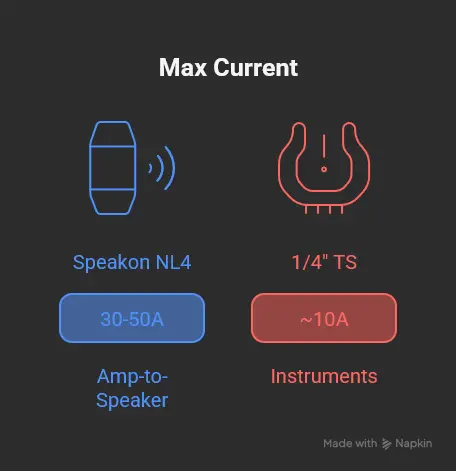
Speakon connectors are designed to carry serious current — 30 amps continuous on the standard NL4 series, and up to 50 amps on heavy-duty STX versions. The contacts are recessed and touch-proof, so you can’t short anything out when plugging or unplugging.
Here’s how they compare with older connectors:
|
Connector |
Max Current |
Locking |
Shock-Safe |
Typical Use |
|
1/4" TS |
~10A |
No |
No |
Instruments |
|
XLR |
~15A |
Partial |
No |
Line-Level Signals |
|
Speakon NL4 |
30–50A |
Yes |
Yes |
Amp-to-Speaker |
That safety margin alone saves thousands in potential amp repairs each year for touring companies.
You Can’t Mix Them Up by Mistake
On a dark stage, you can’t confuse a Speakon cable with a mic or guitar lead. It’s a completely different shape, and it won’t even fit into the wrong jack. That’s intentional — it prevents anyone from plugging a high-power signal into a low-voltage input.
That small design decision has protected countless amps and speakers from damage. It’s one of those “why didn’t they always do it this way?” innovations.
Understanding the Speakon Lineup
Poles, Pins, and What They Mean
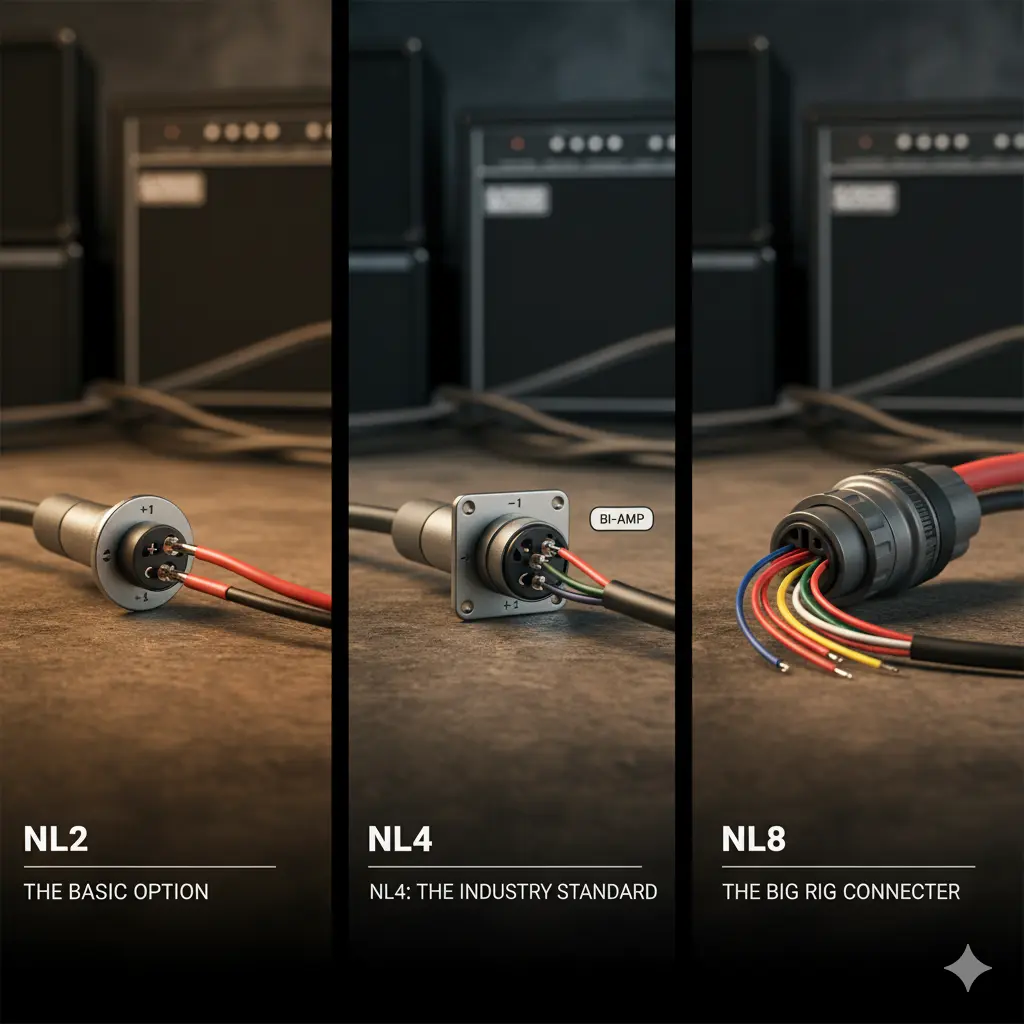
A “pole” is one contact inside the connector. You need two poles (+ and –) to send one audio channel. Speakon connectors come in 2-pole, 4-pole, and 8-pole versions — letting you send one, two, or even four amplifier channels through a single cable.
NL2: The Basic Option
- 2 poles: +1 and –1
- Great for simple mono setups
- Common in smaller portable systems
An NL2 plug fits perfectly into an NL4 jack (it uses +1/–1 pins), but an NL4 plug doesn’t fit an NL2 jack. Remember that rule — it’s saved many techs a lot of head-scratching.
NL4: The Industry Standard
The 4-pole NL4 is the one you see everywhere. It has two sets of contacts: +1/–1 and +2/–2. That means you can send two different signals down the same cable — perfect for bi-amped speakers or dual-channel monitor setups.
|
Setup |
Pins Used |
Description |
|
Single Channel |
+1 / –1 |
One amplifier channel |
|
Bi-Amp |
+1 / –1 and +2 / –2 |
Low and high frequencies |
|
Stereo |
+1 / –1 (Left), +2 / –2 (Right) |
Two channels in one cable |
Most PA systems today are wired this way. It keeps the stage tidy and the gear organized.
NL8: The Big Rig Connector
The 8-pole NL8 is for heavy touring rigs and line arrays. It carries four full amplifier channels (+1/–1 through +4/–4) in one large connector. For massive systems, it replaces a handful of separate cables, cutting setup time dramatically.
When a stage crew can wire an entire line array with just a few thick NL8 cables, that’s time saved — and fewer mistakes under pressure.
Wiring Gotchas: Why NL4 Standardization Still Matters
Here’s where even experienced techs sometimes get tripped up: there’s no single global wiring standard for NL4 connectors.
Some amplifiers send one channel on +1/–1, others use +2/–2 for bridged mono. If you assume, you risk either silence or — worse — damage.
Simple best practice:
- Always check the manual for your amplifier and speaker before wiring.
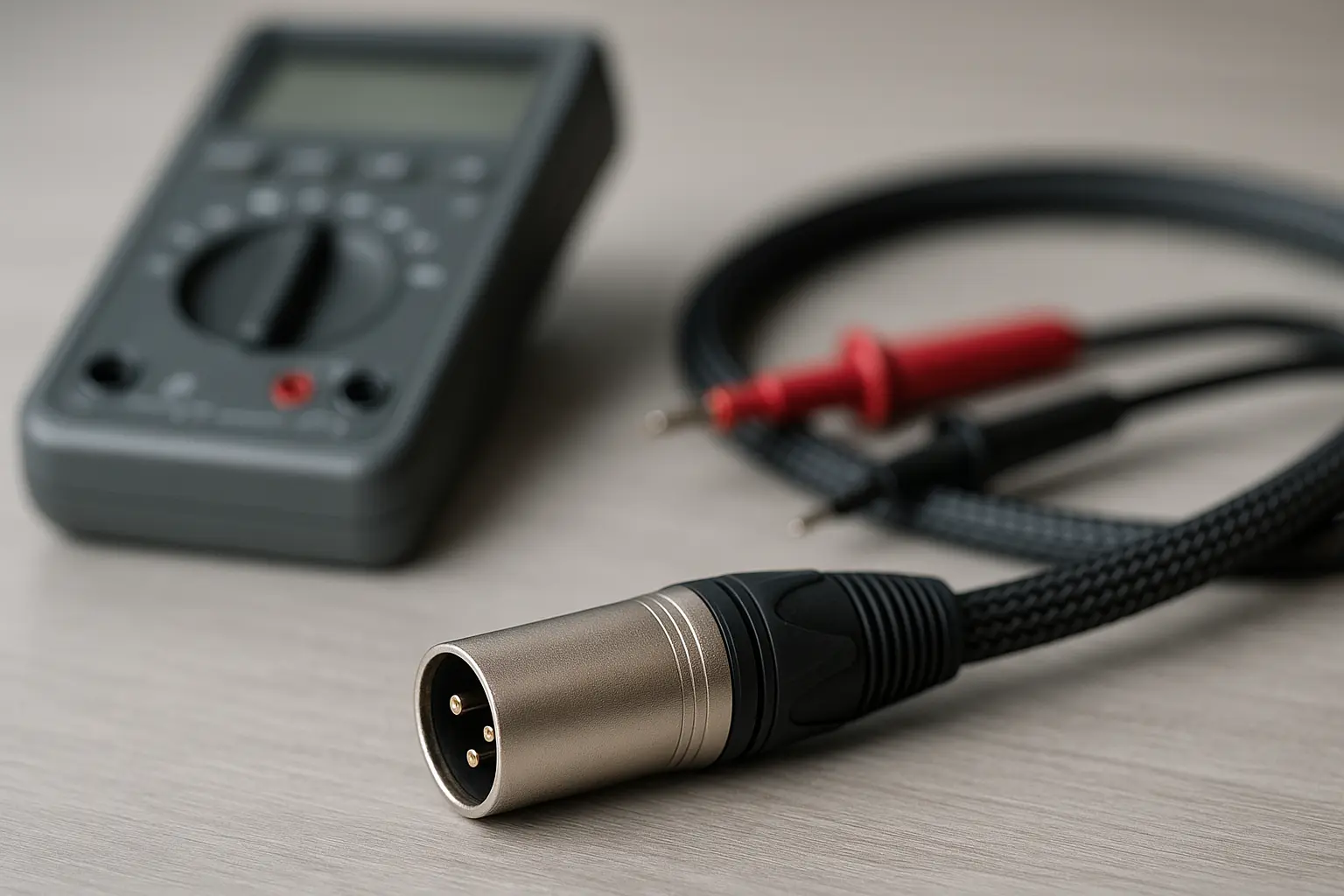
- Use a continuity tester or multimeter to confirm pinouts.
- Label cables clearly: “Bi-Amp – LF on +1/–1, HF on +2/–2.”
Good documentation saves time and gear.
Why Cheap Knockoffs Aren’t Worth It
What Actually Goes Wrong
The market’s full of imitation Speakon connectors that look fine online but fall apart in real use. They often use cheap plastic, have sloppy tolerances, or seize inside genuine jacks.
A user on Reddit shared:
“Our main speaker went silent mid-show. Turned out a $5 clone connector cracked inside the amp panel. Never again.”
Bad connectors can also cause distortion and intermittent audio that’s hard to trace — a nightmare during live events.
The Real Cost of “Saving Money”
Let’s look at what a bad connector can really cost:
|
Failure |
Cheap Fix? |
Real-World Cost |
|
Cracked housing |
$5 part |
$200 amp repair |
|
Shorted output |
$5 part |
$2,000 replacement |
|
Lost channel during show |
— |
$50,000 event refund |
|
Damaged brand reputation |
— |
Priceless |
Those numbers make the case clear: cutting corners here doesn’t save money, it just shifts the cost to later — often during a live performance.
For U.S. Businesses: Sourcing Matters More Than Ever
The Problem with Generic Parts
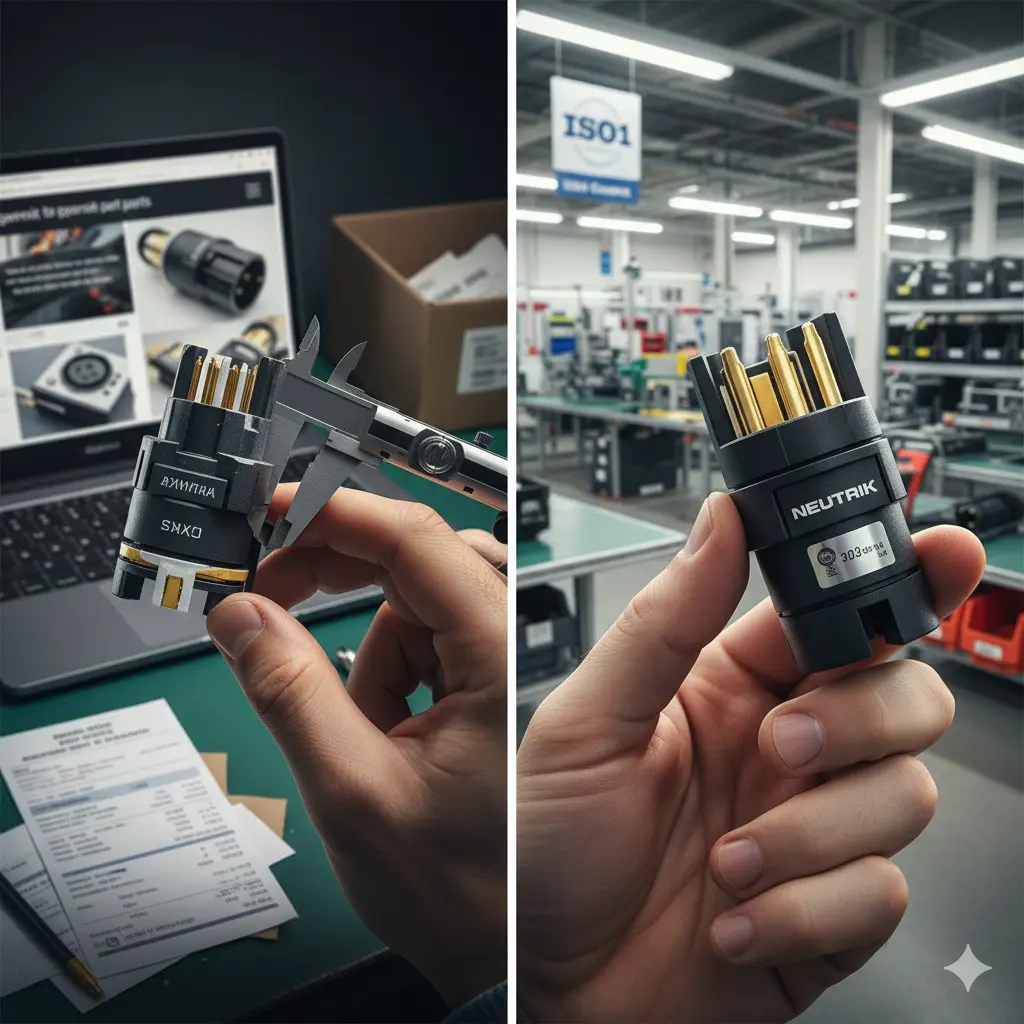
Many U.S. integrators and audio brands rely on overseas suppliers. While that can work well, it also introduces risk — especially with so many counterfeit connectors on the market. Photos can be misleading, quality can vary between batches, and warranty support is often nonexistent.
Finding a reliable OEM partner has become just as important as product design.
A Reliable Example: Jingyi Audio
A good example of a stable OEM option is Ningbo Jingyi Electronic Co., Ltd.
Based in China with over 30 years in connector manufacturing, they’ve built a reputation for consistent quality and flexible OEM/ODM service.
Key facts:
- Over 15,000 m² of production space
- 120+ staff with long-term industry experience
- Production in both China and Thailand, reducing shipping delays and tariff impact
- Product lines covering XLR, 1/4", Speakon-style connectors, and cables
For U.S. companies building private-label audio gear, Jingyi offers stable supply and proven engineering.
From OEM to Brand: The ZZYZX Move
After decades of manufacturing for other brands, Jingyi launched its own label, ZZYZX, in 2023. This was more than a rebrand — it signaled confidence in their own production quality.
ZZYZX connectors fill the gap between high-end Neutrik and unreliable no-names. For many U.S. businesses, they represent a “sweet spot” — dependable quality without the inflated price tag.
You can meet them in person at NAMM 2025 (Anaheim, Booth 11541C) or ISE 2025 (Barcelona, Booth 6B750).
Building and Maintaining Speakon Cables
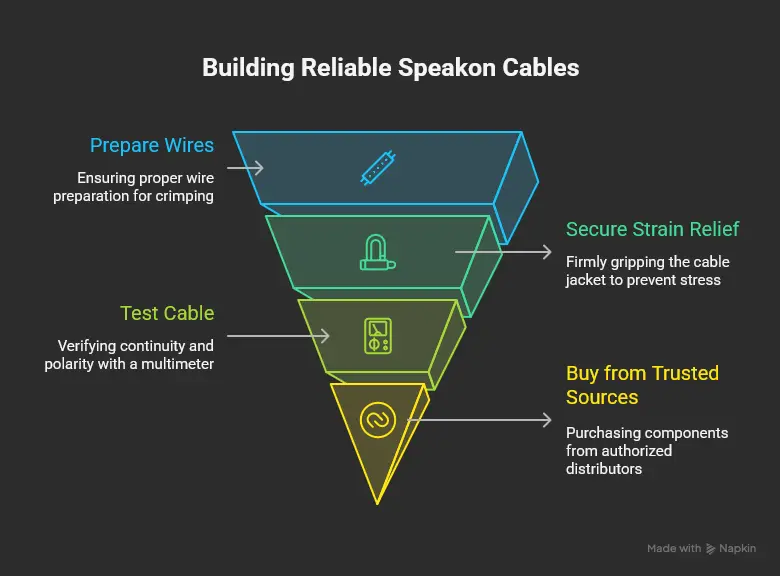
A few practical rules separate pro cable builders from amateurs.
- Prepare Wires Correctly
Never tin wire ends before crimping. Solder softens under pressure and can cause loose contacts later. Use proper ferrules and the correct screwdriver (Pozidriv #1) when tightening screws.
- Secure Strain Relief
Tighten the back clamp so it grips the cable jacket firmly. If the outer jacket slips, the inner wires take the stress — and fail over time.
- Test Before You Trust
Use a multimeter to verify continuity and correct polarity on every new cable. It’s the easiest insurance you can buy.
- Buy from Trusted Sources
Authorized U.S. distributors like Mouser, Parts Express, or Redco Audio — or direct from the manufacturer — will ensure you get genuine components.
What’s Ahead for Speakon Connectors
Even in 2025, Speakon isn’t standing still. Here’s what’s next:
- Outdoor-ready versions: IP-rated designs for festivals and installs
- Smart monitoring: Prototypes that track temperature or current in real time
- Greener materials: More recyclable plastics and lower-carbon manufacturing
- Hybrid connectors: Combining speaker power and data for modern DSP systems
So while technology keeps changing, Speakon keeps adapting — just as reliable, just as essential.
FAQ
Q1: Can I plug an NL2 cable into an NL4 jack?
Yes. It will use the +1/–1 pins. But an NL4 plug won’t fit an NL2 jack.
Q2: Are Speakons for passive speakers only?
Almost always. They carry high-current signals from an amplifier. Active speakers use XLR or TRS cables for line-level input.
Q3: Why isn’t there a single NL4 wiring standard?
Different manufacturers use different pin setups. Always check manuals and label your cables.
Q4: How do I know a connector is genuine Neutrik?
Look for crisp molding, the Neutrik logo, and a hologram label. Fakes often have rough edges or spelling mistakes.
Q5: Can I use Speakons outdoors?
Yes, but use weather-sealed STX or SPX versions to prevent corrosion.
Q6: What cable gauge works best?
12-gauge for most speaker runs under 25 feet; 10-gauge for high-power amps or longer runs.
Q7: How can I convert from banana plugs to Speakon?
Use adapter panels or rewire the cable directly — just make sure polarity is correct.
Q8: What are the most common failures with cheap connectors?
Loose locks, cracked housings, and poor internal contact. They often fail after a few uses.
Q9: Why don’t home stereos use Speakons?
Most home systems don’t need that much current handling, but many DIY audiophiles still prefer them for their safety and clean look.
Q10: What should OEM buyers check before choosing a supplier?
Certifications like ISO 9001, RoHS, and UL, plus proof of stable long-term production and consistent QC data.
Closing Thoughts
The Speakon connector solved problems that used to be routine in pro audio: loose plugs, shorts, hum, and damaged amps. It did that by being simple, strong, and foolproof.
For anyone running a serious system — or building one for customers — using high-quality Speakons and sourcing from reliable OEMs isn’t optional. It’s the difference between a flawless show and a silent stage.
As 2025 brings new technologies and bigger expectations for reliability, the same truth holds: if you want your sound system to work every time, start with the right connection.
External Links