

The Ultimate Guide to Choosing the Best RCA Cable for Record Player (2025 USA Edition)
Key Takeaways
- A proper RCA cable for record player must be built for tiny phono signals, not regular line-level audio.
- Low capacitance, good shielding, and a stable ground connection make the biggest difference in noise and clarity.
- Real stories from Reddit, AudioScienceReview, and vinyl forums show exactly what goes wrong when people pick the wrong cable.
- U.S. brands and OEM buyers need cables with real electrical specs—not generic RCA lines with unknown capacitance.
- JINGYI Audio already builds low-noise OFC copper cables and can support American OEM customers needing custom phono RCA solutions.
Choosing an RCA cable for record player sounds simple, but anyone who has dealt with hum, buzzing, or flat-sounding treble knows it isn’t. Turntable signals are extremely weak. They act almost like microphone signals—they pick up everything. If the cable isn’t built for phono use, the noise becomes obvious fast.
This guide breaks down what actually matters, what real users have experienced, and what U.S. OEM buyers should ask for when sourcing phono cables.
What an RCA Cable for Record Player Actually Does
Phono Signals Are Tiny, So the Cable Matters
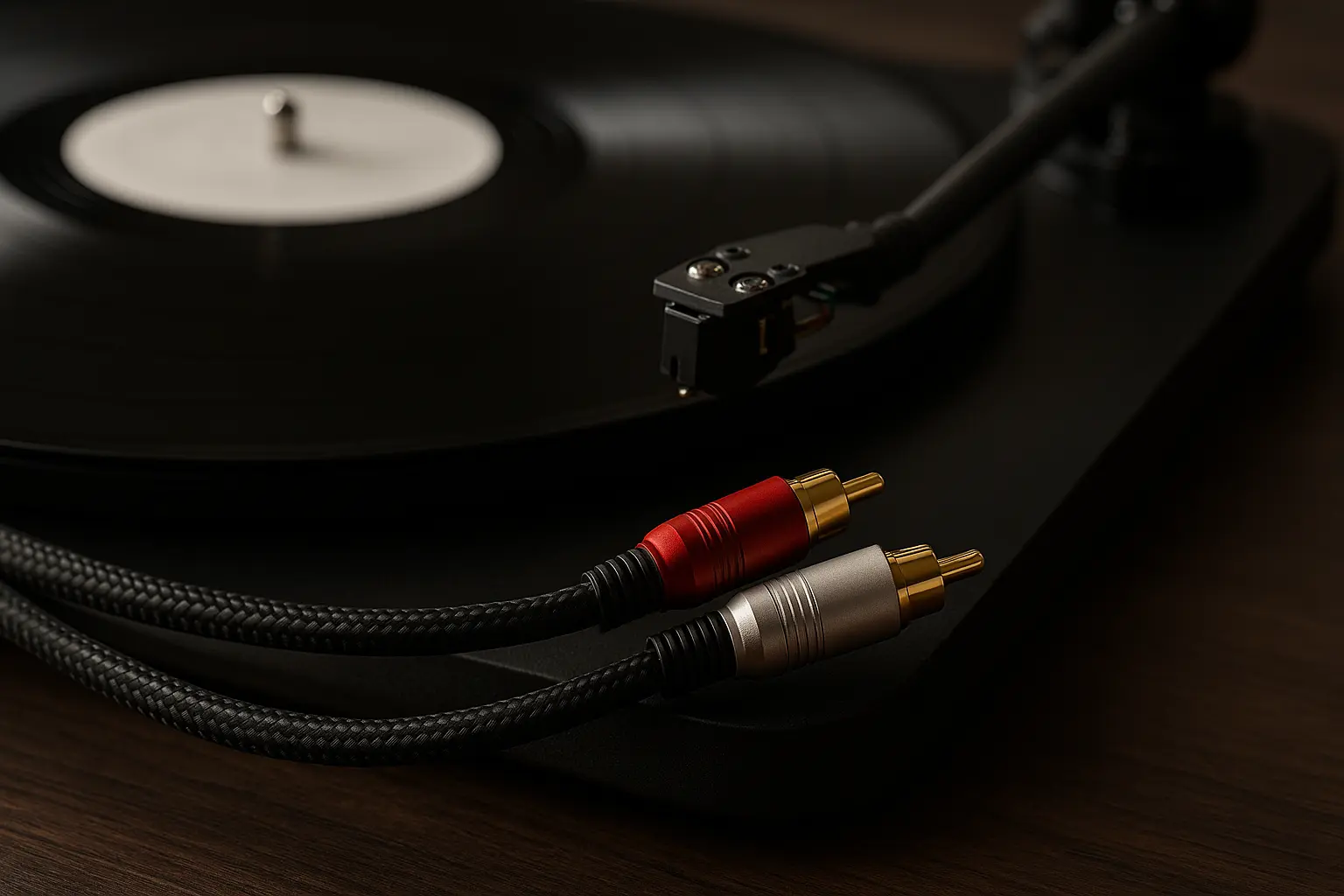
Most RCA cables are made for devices like CD players, DACs, or streamers. Those products send out a strong line-level signal. Turntables don’t. A typical MM cartridge sends only about 2–5 millivolts, and some MC cartridges send even less.
This tiny signal is why vinyl setups are so sensitive to:
- Hum
- RFI
- Cable movement
- Bad shielding
- High capacitance
If the cable is wrong, you’ll hear it right away.
Why Turntable Cables Pick Up Noise Easily
A cartridge generates electricity from tiny movements of the needle. Any nearby interference—Wi-Fi routers, phone chargers, power strips—can get into the cable. Once your phono preamp boosts the signal, this noise becomes obvious.
The RIAA Curve Makes Cable Problems Louder
Your phono preamp boosts the bass and trims the treble. That means:
- Low-frequency hum gets much louder
- Treble problems from high capacitance become easier to hear
This is why phono cables have their own set of rules.
The Important Specs for Any RCA Cable for Record Player
Capacitance — The Most Important Spec for MM Cartridges
Capacitance affects how the cable interacts with your cartridge. High capacitance makes vinyl sound dull, harsh, or uneven.
A good target:
- Below 100 pF/m → ideal for MM
- 150 pF/m or more → often causes problems
Real Example (PS Audio Forum)
A user swapped a 52 pF/m cable for one rated around 240 pF/m.
Their description:
“Treble collapsed. Everything sounded wrong.”
This happens often when people buy bigger, thicker “premium” cables without knowing the specs.
MC cartridges are less sensitive, but low capacitance still helps.
Shielding — Your First Defense Against Hum
Turntables are extremely sensitive to noise. Shielding quality can be the difference between silence and a loud 60 Hz buzz.
Common shielding setups:
- Braided shielding → strong option for phono
- Foil shielding → good for high-frequency noise, weaker for hum
- Dual shielding → best for noisy rooms or long cable runs
Real Example (LencoHeaven)
A user bought a thin “digital audio cable” with no shielding at all.
What happened?
“Hum was terrible. Got louder when I touched the cable.”
One swap to a proper shielded cable fixed it immediately.
Ground Wire — When You Need It
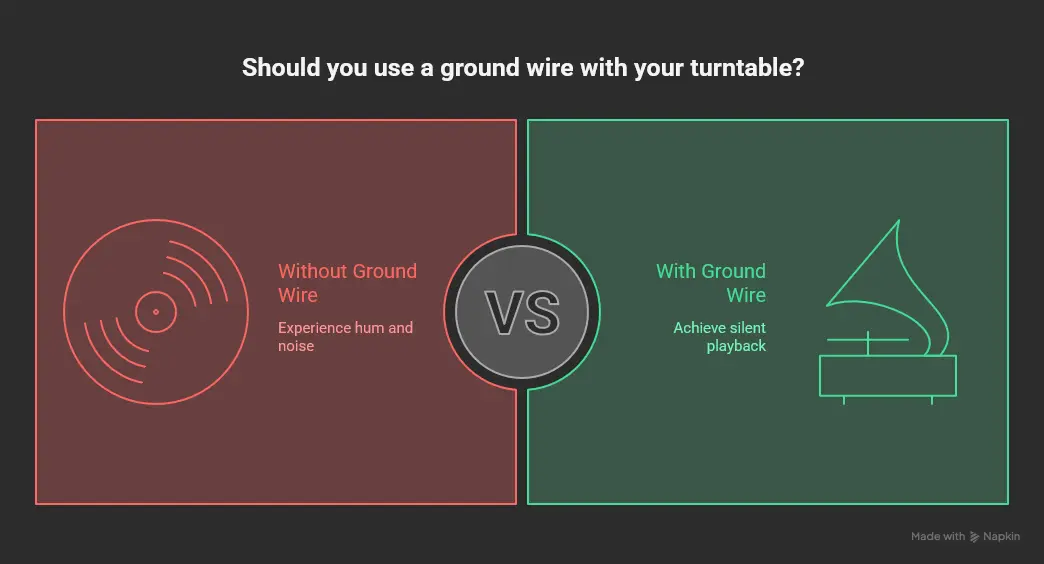
Many turntables come with a separate ground wire to reduce hum.
You need a ground wire when:
- Your turntable has a ground post
- Your preamp or amplifier has a “GND” screw
- Touching the tonearm changes the noise
- You hear a steady 60 Hz hum
Real Example (Reddit r/vinyl)
A beginner connected their turntable without grounding it:
“Hum sounded like an air conditioner.”
After adding the ground wire:
“Dead silent.”
Real Problems Vinyl Users Face (from Actual Social Media Posts)
- Hum from Weak Shielding
Common signs:
- Hum increases near power cables
- Noise changes when touching the wire
- Buzzing that gets louder at higher volume
- Treble Loss from High Capacitance
People often think thicker cables are better. Not true for vinyl.
High capacitance can make:
- Cymbals dull
- Voices cloudy
- Highs disappear
- Ground Loops
If the turntable and amp are grounded differently, hum shows up fast.
A simple ground wire often fixes it.
These issues come up daily on Reddit, ASR, SteveHoffman, and several vinyl groups.
How to Choose the Right RCA Cable for Your Record Player
Keep the Cable Short
Ideal lengths:
- 0.5–1 meter → best
- 1.5 meters → still okay
- 2+ meters → risky
- 3+ meters → often noisy
U.S. homes have lots of electronics, so keeping phono cables short helps avoid interference.
Pick the Right Materials
Not all copper is equal.
- OFC 99.99% copper → best value + stable quality
- Silver-plated copper → optional upgrade
- Pure silver → usually unnecessary
- CCA (copper-coated aluminum) → not recommended for phono
JINGYI Audio uses OFC 99.99%, which makes sense for phono cables.
When Upgrading Your Cable Makes Sense
Upgrade if:
- You hear hum
- You upgraded your cartridge
- Your cable has no shielding
- You don’t know the capacitance
- The cable is longer than 2 meters
Skip upgrading if:
- Your turntable already has a built-in phono preamp
- You already own a low-capacitance cable
What U.S. OEM/B2B Buyers Should Look For
(This is your unique angle that competitors don’t cover)
- Capacitance Specs Must Be Listed
Many factories around the world sell RCA cables without listing capacitance.
For MM cartridges, this is a serious problem.
U.S. audio brands often need:
- Verified pF/m results
- Consistent specs across batches
- Shielding tests
- Cable samples for electrical testing
- Material Stability and Customization
OEM buyers in the U.S. typically expect:
- Long-term material consistency
- Flexible cable lengths (0.5m / 1m / 1.5m)
- Private-label options
- Ground-wire versions
- Stable connectors and jackets
- Why JINGYI Audio Fits U.S. OEM Needs
JINGYI Audio already produces:
- OFC 99.99% copper cables
- Low-noise shielded audio lines
- Custom cable assemblies
- B2B-friendly manufacturing
- OEM white-label support
They also have the ability to develop a low-capacitance phono RCA line, which the U.S. market currently lacks in reliable bulk supply.
Recommended RCA Cable Types for Different Turntable Users
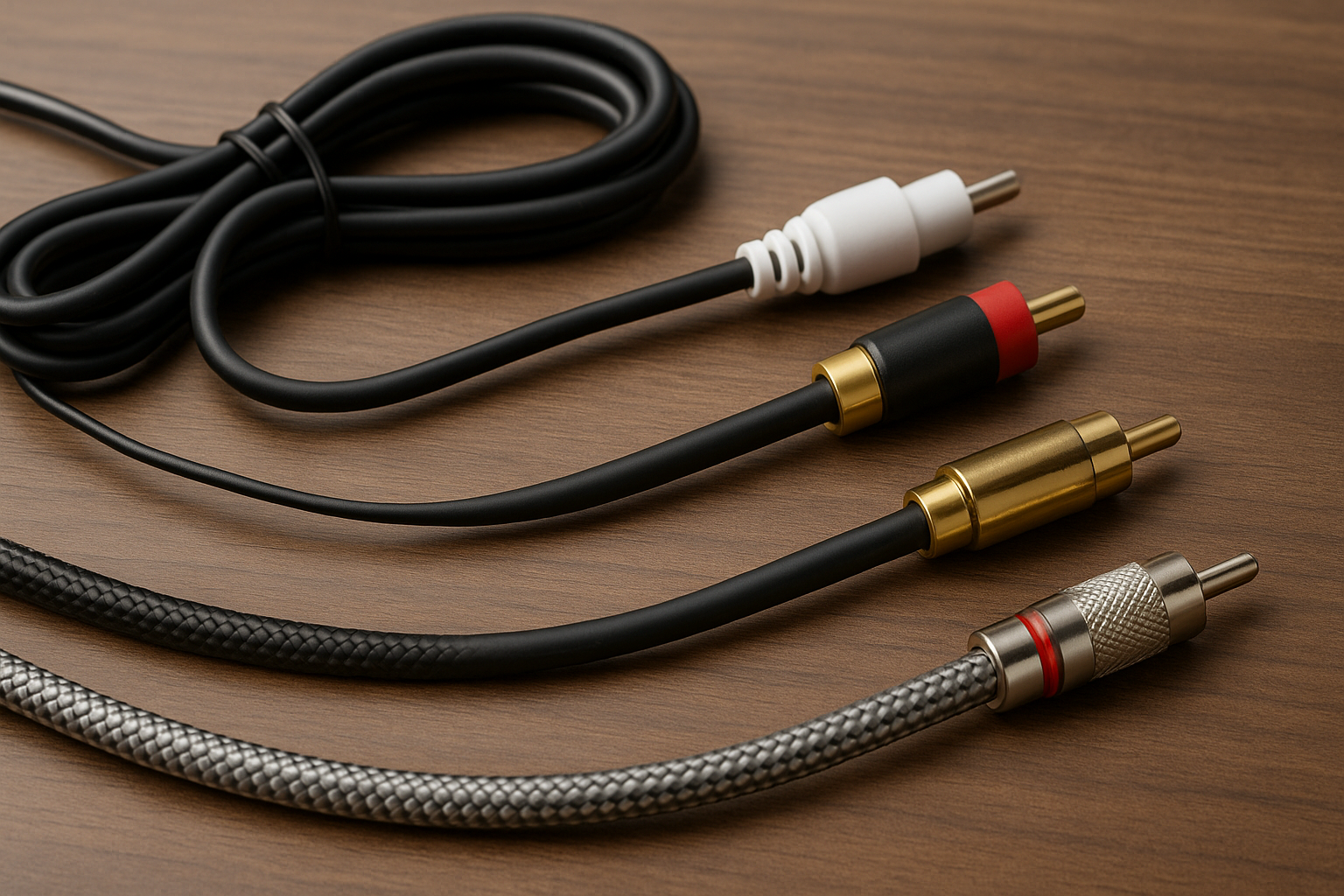
For Beginners (Budget-Friendly)
Look for:
- Basic shielding
- 1-meter length
- OFC copper
- Optional ground wire
For Mid-Level Setups
Better features:
- Known capacitance
- Braided shielding
- Gold-plated plugs
For Audiophiles
Top-tier options:
- Dual shielding
- Silver-plated OFC
- Low dielectric insulation
- Verified <80 pF/m
How to Connect RCA Cables and Ground Wire to Your Record Player
Simple Setup Steps
- Match red and white RCA plugs to the turntable outputs.
- Attach the ground wire to the GND screw on the preamp.
- Keep phono cables away from power cords.
- Turn on the system and check for noise.
- Move cables around if hum appears—small changes can help.
Common Mistakes
- Using digital coax cables
- Forgetting the ground wire
- Running long phono cables
- Choosing unshielded cables
- Placing the cable near your router or subwoofer
FAQs About RCA Cables for Record Players
- Do I need a special RCA cable for a record player?
Yes. Vinyl uses phono-level signals, which require a shielded, low-capacitance cable. - Why does my turntable hum?
Often shielding or grounding issues. - Can I use a long RCA cable?
Try to stay under 1 meter. - Do I always need a ground wire?
Not always, but most turntables without built-in preamps need one. - Does OFC copper matter?
Yes. It’s more stable and lowers noise. - What capacitance should I look for?
Below 100 pF/m for MM cartridges.
Citations
- AV.com – Stereo Phono & RCA Cables
https://www.av.com/stereo-phono-rca-cables - AV-Connection – Turntable Audio Cables
https://www.av-connection.com/?ML=2808 - The Vinyl Factory – Guide to Cables
https://www.thevinylfactory.com/features/a-guide-to-cables-turntable-audio-amplifier - maPlatine – Phono vs Interconnect
https://www.maplatine.com/en/content/309-what-is-the-difference-between-phono-cable-and-interconnect-cable - What Hi-Fi – Best Audio Cables
https://www.whathifi.com/best-buys/accessories/best-audio-cables