

The Ultimate Guide to Microphone Cable Shielding: How to Eliminate Noise for Pro Audio
Key Takeaways
- Shielding Works as a System:Noise reduction isn't just about the shield itself—it's how the shield type, balanced cable design, and proper grounding work together.
- Durability Beats Marketing Claims:For most professional audio work (live sound, touring), a tough braided shield beats a foil shield hands down, despite foil's "100% coverage" marketing pitch. Audio engineers on Reddit and Gearspace confirm this from real-world use.
- The Right Shield for Your Needs:Spiral shields balance flexibility and performance perfectly, making them smart choices for general studio work and OEM products like Jingyi Audio's CM001 cable.
- Your Equipment Matters Too:Issues like "Shield-Current-Induced Noise" (SCIN) and the "Pin 1 Problem" prove that even the best cable can fail when connected to poorly designed equipment.
- OEM Partnerships Make the Difference:For B2B buyers in the US market, working with experienced OEM/ODM manufacturers like Jingyi Audio means access to customizable solutions that meet your performance, durability, and compliance requirements including RoHS and REACH certifications.
The Unseen Enemy: Understanding EMI and RFI in Your Audio Signal
What's the Difference Between EMI and RFI?
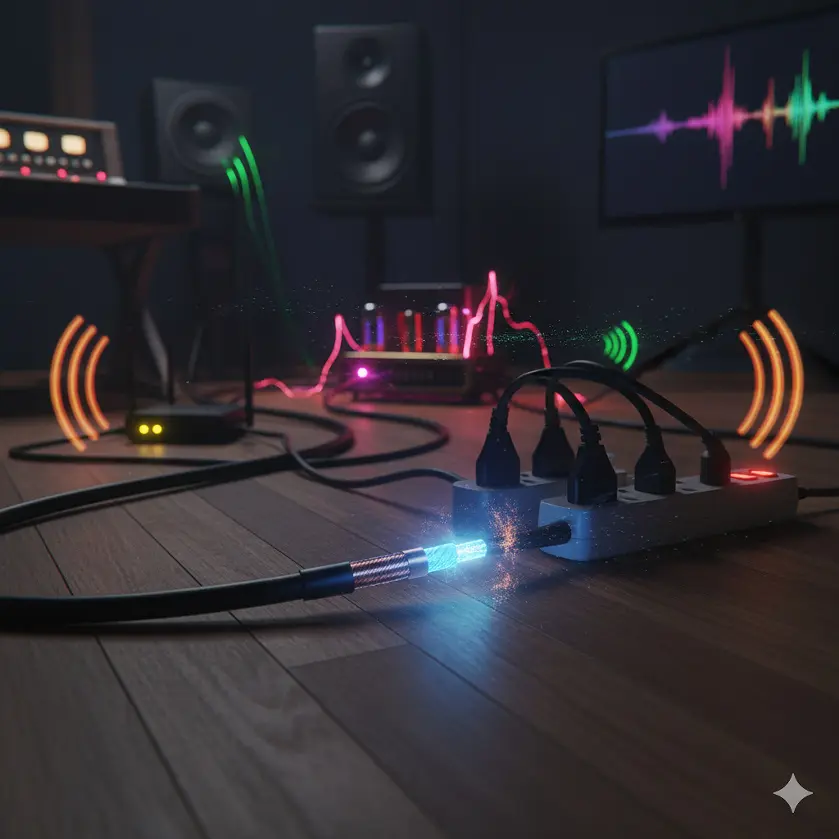
Electromagnetic Interference (EMI) covers any electrical or electromagnetic disturbance that degrades signal quality. Radio Frequency Interference (RFI) falls under the EMI umbrella but happens specifically within the radio frequency spectrum. The physics is straightforward: alternating current generates electromagnetic fields, and those changing fields can induce unwanted currents in nearby conductors.
When your microphone cable runs near power lines, lighting dimmers, or large transformers, the strong electromagnetic fields from these devices create tiny unwanted currents in the cable's conductors. These interference currents stack on top of your original audio signal and show up as audible hum, buzz, or noise in your recordings.
Common EMI/RFI sources in professional spaces:
- Motors and motor control centers (MCCs)
- Fluorescent lighting and LED dimmers
- Wireless routers and cellular devices
- Power supply units and DC converters
- Digital equipment and switching circuits
How Your Microphone Cable Becomes an Antenna
Long cables running across stages or through studios don't just carry signals passively—they act as efficient antennas. They radiate their own electromagnetic fields (which can mess with other equipment) and pick up electromagnetic noise from everything around them.
With Wi-Fi, Bluetooth, cellular networks, and wireless mic systems everywhere now, our electromagnetic environment has become incredibly crowded and noisy. This dense RF environment creates bigger challenges for shield design. A shielding solution that worked ten years ago might not cut it anymore.
This is where the cable shield comes in. The shield layer—basically a conductive layer (usually metal) wrapped around the signal conductors—works like a Faraday cage. It protects your signal two ways:
- Reflection: Bouncing external electromagnetic waves away before they penetrate the shield
- Absorption and Grounding: Soaking up leftover electromagnetic energy and safely sending it to ground through a low-resistance path where it dissipates harmlessly
Here's the critical part: An ungrounded shield doesn't just fail to protect—it can actually make things worse through the "antenna effect," coupling even more noise. Proper grounding isn't optional. It's required for the shield to work at all.
The Great Debate: A Practical Comparison of Microphone Cable Shielding Types
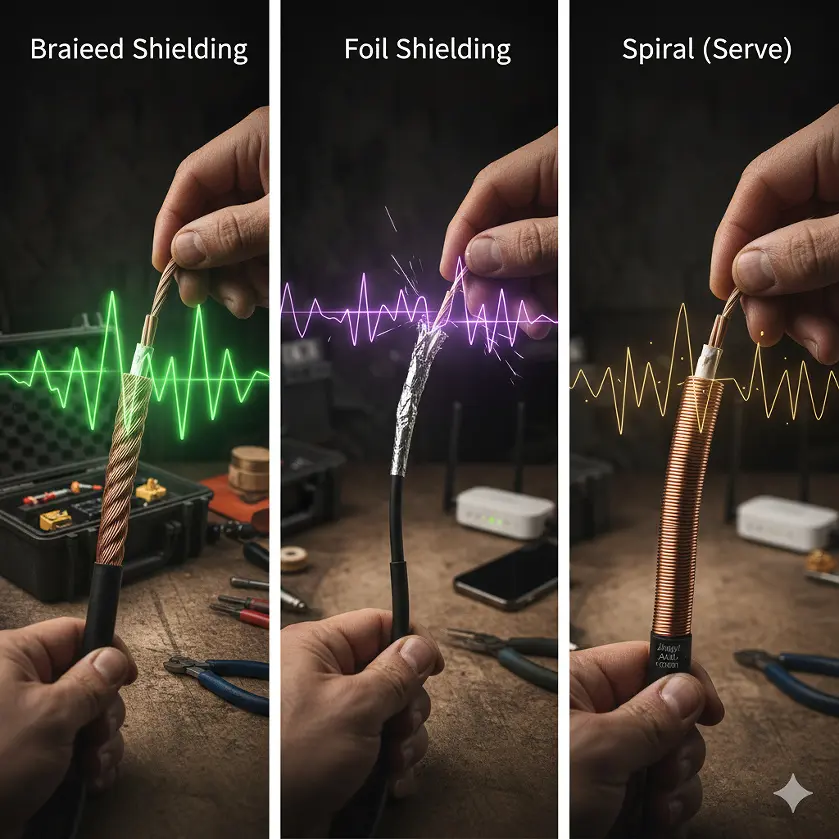
Understanding different shielding designs helps you make smart purchasing or specification decisions. Let's examine the three most common types used in microphone cables, backed by technical data and real-world user experience.
Braided Shielding: The Touring Standard for Durability and Low-Frequency Noise
Structure: Braided shielding consists of multiple strands of fine copper wire (bare or tinned) woven into a mesh pattern, typically providing 70-95% coverage.
Performance Strengths:
- Excellent performance across low-to-mid frequency ranges (covering the entire audio spectrum)
- Provides extremely low DC resistance ground paths for noise current
- Technical research confirms that at frequencies below 4 MHz, braided shielding beats foil shieldingin noise reduction
Physical Characteristics: The high mechanical strength makes braided shields the go-to choice for applications with frequent movement and flexing—stage performances, touring, and studio patch cables. The robust woven structure holds up through long-term physical wear.
Real-World Proof: User experiences from Reddit's r/audioengineering community back this up completely. In discussions about DIY XLR cable construction, professional audio engineers consistently say that for any scenario with movement, bending, or foot traffic (stage performances, touring), braided shielding is the only reliable choice thanks to superior durability.
One Gearspace forum user captured the professional consensus: "I only use Mogami cables. Yes, mic cables can pick up noise—mainly when they're aging and need replacement or when poorly shielded. I've had mic cables receive radio frequencies before—all cheap cables. I only use quality, expensive cables."
Drawbacks:
- Higher manufacturing cost
- Harder to terminate (solder) compared to other types
- Small gaps ("windows") in the braid mesh may allow some high-frequency RFI through (though this barely affects audio applications)
Foil Shielding: The Truth About 100% Coverage and Its Real-World Limits
Structure: Foil shielding uses a thin layer of aluminum foil laminated with a polyester (Mylar) backing for mechanical strength. It typically includes a "drain wire" to make termination and grounding easier.
What the Spec Sheet Says:
- Provides 100% physical coverage
- Theoretically excellent shielding against high-frequency RFI (above 100 MHz)
The Reality Check: Social media user experiences reveal foil shielding's fatal weakness in actual use.
A Gearspace user put it perfectly: "Foil shielding technically performs better, but you really only want to use it in permanent installations because in studio/field use, repeated wear will cause it to fail."
Technical Reality: Because aluminum foil has inherently high resistance, its shielding performance at low frequencies falls short of braided shielding. This creates real problems for microphone cables that mainly carry low-frequency signals.
Physical Vulnerability:
- Extremely poor flex life
- Tears easily from repeated bending or being stepped on
- User community strongly recommends limiting foil shielding to permanent, stationary, fixed installations only
Shield-Current-Induced Noise (SCIN) Problem: Research reveals a fundamental design flaw in foil shielding. The foil-plus-drain-wire design performs worst in SCIN tests because most shield current concentrates in the single drain wire, which amplifies magnetic field coupling problems and produces the strongest SCIN. Braided shielding performs 30 dB better at audio frequencies because current spreads more evenly across the entire braid mesh.
Bottom Line: For microphone applications, foil's "100% coverage" is basically a misleading marketing claim. Its high-frequency advantages don't matter much for cables mainly carrying low-frequency signals, while its low-frequency performance and durability problems are deal-breakers.
Spiral (Serve) Shielding: The Flexible Middle Ground for Studios and OEM Manufacturing
Structure: Spiral shielding uses single or multiple copper strands wrapped in a helix around the cable core, offering coverage up to 98%.
Performance Characteristics:
- Works well within the audio frequency range (low frequencies)
- More flexible than braided shielding and easier to terminate, making it cost-effective and efficient for manufacturing
- Common choice for microphone and instrument cables where flexibility matters
Manufacturing Benefits: From a cost perspective, spiral shielding needs less copper material and faster manufacturing speeds, which means lower costs. Termination is also faster and easier than braided shielding. These factors make copper spiral a popular choice for audio cables.
Real-World Example: "Manufacturers like Jingyi Audio use spiral shields in versatile products like their CM001 XLR cable (featuring Spiral 64/0.1 OFC construction), giving you excellent flexibility and solid audio-frequency performance for studio and general-purpose work. This design choice reflects a clear engineering trade-off: optimizing for manufacturability, cost control, and flexibility while maintaining adequate protection in the audio frequency range."
Drawbacks:
- The helical structure creates an "inductor-like" coil effect, making it unsuitable for high-frequency signal transmission
- Lower tensile strength compared to braided shielding
- When the cable bends, gaps can form between spiral strands, letting interference through
Worth Noting: Some high-end cable manufacturers (like Canare) explicitly avoid using spiral shielding in their products because of this limitation.
Combination Shielding: Maximum Protection for Extreme Environments
Structure: Typically combines a foil shield with an outer braided shield layer.
Performance Benefits:
- Gets you the best of both: foil provides 100% high-frequency coverage while braid provides a low-resistance ground path and robust low-frequency shielding
- Delivers maximum shielding performance across the entire frequency spectrum
Best Used For: Extremely harsh electromagnetic environments
Shield Type Comparison Table
|
Characteristic |
Braided |
Foil |
Spiral/Serve |
Combination |
|
Coverage |
70-95% |
100% |
95-98% |
100% |
|
Works Best At |
Low to mid (audio) |
High (>100 MHz) |
Low (audio) |
Full spectrum |
|
Mechanical Strength |
Excellent |
Poor |
Good |
Excellent |
|
Flex Life |
Good |
Very Poor |
Excellent |
Good |
|
Low-Freq Noise Rejection |
Excellent |
Poor (SCIN issue) |
Good |
Excellent |
|
Cost |
High |
Low |
Medium |
Highest |
|
Best Application |
Stage/Touring/Studio |
Permanent Fixed Install |
Mic/Instrument Cables |
Extreme EMI Environments |
Beyond the Physical Shield: Why Balanced Connections Are Your Secret Weapon
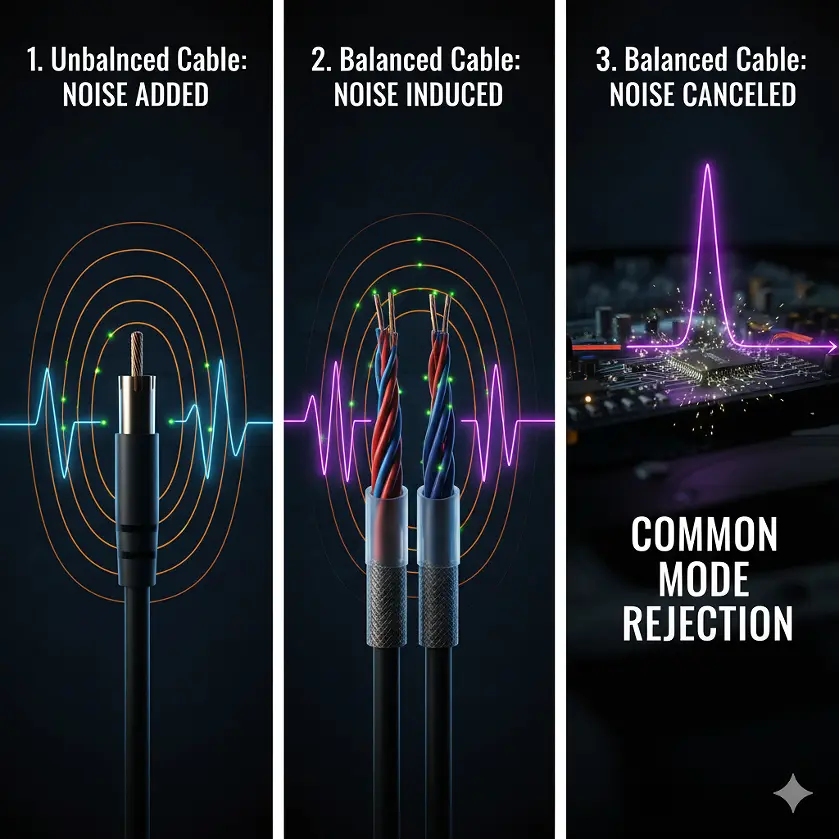
Physical shielding is your first line of defense against noise, but balanced circuit design is your second, more sophisticated defense. Together, they form the foundation of professional audio signal transmission.
How Common Mode Rejection Magically Cancels Noise
Unlike unbalanced cables that use only one signal wire and one ground/shield wire, balanced cables use a three-wire system:
- Pin 1: Ground/Shield
- Pin 2 (Hot): Carries the positive polarity (+) signal
- Pin 3 (Cold): Carries the negative polarity (-) signal (flipped 180 degrees)
Here's the concept: at the sending end, the same audio signal gets duplicated. One copy travels through the hot pin at its original polarity, while the other gets phase-inverted 180 degrees and travels through the cold pin.
When external electromagnetic interference invades the cable, it creates noise voltages of equal size and identical phase on both the hot and cold signal wires. This noise appearing identically on both lines is called "common-mode" noise.
When the signal reaches the receiving equipment (mixer or audio interface), its internal differential amplifier performs a key operation: it inverts the cold signal another 180 degrees. This operation produces two results:
- Signal Addition: The audio signal on the cold pin, originally inverted, returns to its original phase after getting inverted again. It adds with the hot pin's audio signal, doubling signal strength (theoretically +6 dB gain).
- Noise Cancellation: The common-mode noise, originally in phase on both lines, becomes equal in size but opposite in direction because of the cold signal's overall inversion. When added together, the noise perfectly cancels out.
This process is called Common Mode Rejection.
Think of it this way: Imagine two identical sound waves traveling through water. One wave is normal, the other is perfectly flipped upside down. When you add them together, they cancel each other out completely—silence. That's what happens to the noise in a balanced cable.
The Synergy of Shielding and Balanced Lines
Physical shielding and balanced lines are two different but complementary anti-noise technologies:
- Shielding is passive defense: Like a physical barrier, it tries to stop noise from entering the cable
- Balanced lines are active defense: Through smart circuit design, they actively eliminate leftover noise that gets through the shield
As one user on a technical forum put it well: "Completely eliminating all noise through shielding alone is nearly impossible, so balanced design accepts the reality that 'some noise will always get in' and provides a smart way to eliminate it."
Balanced lines work because noise gets induced equally on both signal wires. This is exactly why the cable's physical structure (like tight, uniform twisting of the signal pair) matters so much. If the twisting is uneven, one conductor may sit closer to the noise source, resulting in unequal noise induction and incomplete common-mode rejection, leaving leftover noise.
Common Mode Rejection Ratio (CMRR) measures a device's (like a differential amplifier's) ability to suppress common-mode signals, typically expressed in decibels (dB). Higher CMRR values mean stronger common-mode noise suppression. Ideal differential amplifiers have infinite CMRR, while in real-world applications, high-performance circuits can exceed 100 dB CMRR.
Advanced Insight: The "Pin 1 Problem" and Why Your Equipment Matters
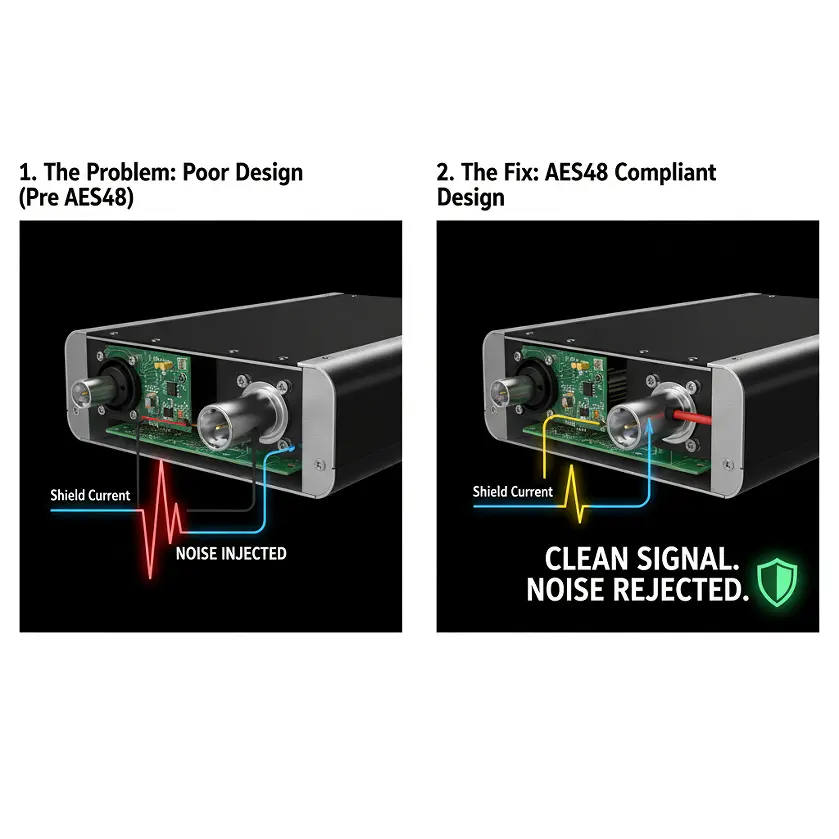
Even with the best cable, your noise reduction efforts can fail because of equipment design flaws. The "Pin 1 Problem," identified by audio engineer Neil Muncy in his landmark 1994 AES paper, reveals a widespread design defect in audio equipment.
Core Principle: The cable shield should work as an extension of the equipment's metal chassis and must connect directly to the chassis at the signal entry point with low resistance.
The Problem: For cost and manufacturing convenience, many equipment manufacturers connect XLR connector Pin 1 (shield connection point) to the internal circuit board ground (signal ground) rather than directly to the chassis. The circuit board ground then connects to the chassis through another wire.
What Goes Wrong: This design creates a section of "common resistance path" between the shield current path and the audio signal ground return. When noise current (like ground loop current or RF interference) flows through the shield, it creates a small voltage drop across this shared path. This noise voltage gets injected directly into the extremely sensitive audio circuit ground reference point, contaminating the audio signal.
The Fix - AES48 Standard: To solve this issue, the Audio Engineering Society created the AES48 standard. This standard explicitly requires that for equipment with metal chassis, Pin 1 must connect directly to the chassis and should never connect directly to circuit ground (signal ground).
For US B2B Buyers: When specifying equipment for OEM projects or system integration, checking AES48 compliance should be part of your purchasing criteria. The best cable in the world can't overcome a fundamental equipment design flaw.
Sourcing for Success: A Guide for US-Based OEM & B2B Buyers
For US-based companies seeking reliable microphone cable suppliers—whether for branded product lines, custom touring rigs, or installation projects—the right OEM/ODM partner makes all the difference.
What to Look for in an OEM/ODM Partner for Custom Microphone Cables
When evaluating potential manufacturing partners for the US market, focus on these key criteria:
- Regulatory Compliance
- RoHS and REACH Certifications: Required for material safety and US/EU market access
- ISO 9001 Quality Management: Shows systematic quality control processes
- Verifiable documentation you can provide to US customs and end clients
- Manufacturing Experience & Reliability
- Established History: Look for 20+ years of manufacturing experience
- B2B Platform Reputation: Positive feedback on platforms like Alibaba (4.5+ star ratings)
- Global Client Base: Experience serving North American and European markets shows understanding of Western quality expectations
- Technical Capabilities
- Engineering Support: In-house team capable of custom cable design
- Material Flexibility: Access to various conductor types (OFC, silver-plated), shield options (braided, spiral, combination), and jacket materials (PVC, rubber, TPE)
- Testing Equipment: Ability to provide test reports for electrical parameters (capacitance, resistance, shielding performance)
- Production Flexibility
- MOQ Scalability: Can handle both small custom runs and large production orders
- Customization Options: Custom branding, connector types, cable lengths, and color coding
- Lead Time Reliability: Consistent delivery schedules that work with US project timelines
- Supply Chain Stability
- Raw Material Sourcing: Established relationships with quality component suppliers (Neutrik, Rean, Amphenol)
- Production Capacity: Sufficient daily output (5,000+ units) to meet demand fluctuations
- Shipping Partnerships: Experience with international freight forwarders and US port logistics
Case Study: Partnering with Jingyi Audio for the US Market
Company Profile: Established in 1992 in Ningbo, China (near Ningbo Port for efficient shipping), Jingyi Audio (site_5615465d-0395-48c6-b01f-dc3d38213fc5) represents a proven manufacturing partner for US B2B buyers seeking professional audio cable solutions.
Manufacturing Credentials:
- 32+ yearsof OEM/ODM experience in professional audio
- 15,000 square meterfacility with automated production lines
- 120+ employeesincluding dedicated engineering, QC, and production teams
- ISO 9001, RoHS, REACHcertified with verifiable documentation
- 9/5 ratingon B2B platforms with positive US customer feedback
Product Capabilities: While Jingyi Audio's standard models like the spiral-shielded CM001 are optimized for flexibility and efficient production (featuring Spiral 64/0.1 OFC shielding, 24AWG OFC conductors, and Φ6.0mm diameter), their real value for US OEM clients lies in their customization capacity.
OEM Customization Examples:
- High-Coverage Braided Shields(>90%) for demanding touring and live sound applications
- Star-Quad Conductor Configurationfor maximum magnetic field rejection in studios near power equipment
- Ruggedized Rubber Jacketsfor stage use requiring superior durability
- Custom Connector Optionsincluding Neutrik, Rean, or client-specified brands
- Private Labelingwith client branding and packaging
US Market Benefits:
- Compliance Documentation: Full RoHS/REACH test reports in English for US customs and client requirements
- English-Speaking Sales Team: Fluent communication for technical specifications and order coordination
- Established Logistics: Experience shipping to US ports (Los Angeles, Long Beach, Newark) with freight forwarding partnerships
- Payment Flexibility: Accepts standard US B2B payment terms including LC and T/T
Typical Lead Times:
- Standard products: 10-15 days for orders up to 5,000 units
- Custom specifications: 25-35 days depending on complexity
- Sample development: 7-10 days for prototype approval
Value Proposition: For US companies needing professional-grade microphone cables that balance performance, durability, and cost-effectiveness, Jingyi Audio's combination of manufacturing expertise, quality certifications, and customization capabilities provides a reliable supply chain solution. Their engineering team can translate specific application requirements (studio recording, live touring, broadcast, installation) into optimized cable specifications.
Frequently Asked Questions (FAQ)
Is a cable with 100% foil shielding always better than one with 95% braided shielding?
No, absolutely not—and this is one of the industry's most persistent myths. For microphone cables that will be moved, stepped on, coiled, or subjected to any physical stress (which describes nearly all professional audio applications), the durability and superior low-frequency performance of a 95% braided shield matter far more than the theoretical 100% coverage of a fragile foil shield.
Real-world evidence from audio professionals consistently supports this: a torn, damaged foil shield provides 0% protection, whereas a robust braided shield maintains its integrity through years of use. Additionally, Shield-Current-Induced Noise (SCIN) research shows that foil shields with drain wires perform 30 dB worse than braided shields at audio frequencies because of current concentration effects.
The bottom line: "100% coverage" is a marketing claim that ignores the mechanical realities of cable use and the specific frequency characteristics of audio signals.
My shielded, balanced cables still have a hum. What's the problem?
If you're experiencing persistent 50/60 Hz hum despite using quality shielded, balanced cables, you're likely dealing with one of two system-level issues:
- Ground Loop: This occurs when audio equipment connects through multiple ground paths, creating a loop through which AC current flows. The solution:
- Connect all interconnected audio equipment to the same power outlet or power strip
- Verify all connections are truly balanced (not pseudo-balanced)
- In extreme cases, use a ground loop isolator or audio isolation transformer (though proper wiring should eliminate the need)
- Pin 1 Problem: The equipment itself may have a design flaw where the XLR connector's Pin 1 isn't properly bonded to the chassis. This violates the AES48 standard and allows shield current to contaminate the signal ground. Unfortunately, this requires equipment modification or replacement—no cable can fix a fundamental equipment design error.
Diagnostic tip: If the hum disappears when you disconnect the cable but reappears when reconnected, the issue is likely a ground loop or Pin 1 problem, not the cable itself.
For a custom OEM order, what specifications matter most for noise reduction?
For maximum noise reduction in professional audio microphone cables, focus on these specifications:
- High-Coverage Braided Copper Shield(>90%): Provides optimal balance of low-frequency noise rejection, durability, and good grounding path. Specify tinned copper for corrosion resistance.
- Star-Quad Conductor Configuration: This advanced internal geometry (four conductors in a specific twisted pattern) provides 10-30 dB additional rejectionof magnetic field interference compared to standard two-conductor designs. Required for environments with nearby power transformers, lighting dimmers, or other magnetic field sources.
- Quality Connectors: Specify reputable brands (Neutrik, Rean, Amphenol) with proper strain relief and metal shells for good shield termination.
- Appropriate Jacket Material:
- PVC for cost-effective fixed installations
- Rubber or TPE for touring and stage use requiring flexibility and durability
- Specify jacket thickness (typically 1.0-1.5mm) for adequate mechanical protection
- Low Capacitance: For long cable runs, specify capacitance ≤100 pF/meter to minimize high-frequency rolloff.
When working with an OEM partner like Jingyi Audio, provide your specific use case (studio, touring, broadcast, installation) so their engineering team can recommend the optimal combination of these parameters.
How do I know if my supplier's shielding claims are legitimate?
Request verifiable test data, not just marketing claims. Legitimate manufacturers should provide:
- Shielding Performance Test Reports: Measured in dB across frequency ranges (typically 10 kHz to 1 GHz)
- Transfer Resistance Data: Lower values indicate better shielding performance
- Physical Coverage Percentage: For braided shields, should specify wire count and weave tightness
- DC Resistance of Shield: Lower resistance = better grounding path (typical: 2-10 Ω per 1000 feet)
Additionally, check for third-party certifications (UL, ETL, CE marks) and request customer references from companies in similar applications. On B2B platforms like Alibaba, look for Transaction Level ratings and verified reviews from US buyers.
What's the difference between shielding for microphone cables vs. instrument cables vs. speaker cables?
This distinction matters for cable selection:
Microphone Cables:
- Low-level signals(millivolts) needing maximum noise protection
- Balanced configuration(XLR) standard
- Shield type: High-coverage braided or spiral required
- Capacitance: Less critical because of low impedance sources
- Top Priority: Noise rejection and durability
Instrument Cables:
- Medium-level signalsfrom guitar/bass pickups
- Unbalanced configuration(TS/TRS 1/4")
- Shield type: Braided or spiral with conductive PVC layer to prevent microphonics (handling noise)
- Capacitance: Critical—high capacitance dulls high frequencies (specify ≤100 pF/ft)
- Top Priority: Capacitance control and physical durability
Speaker Cables:
- High-level signals(watts of power)
- Unbalanced, typically two-conductor
- Shielding: Usually unnecessary—power levels are high enough that noise doesn't matter
- Wire gauge: Critical—must handle current without voltage drop (typically 12-16 AWG)
- Top Priority: Low resistance, current capacity
Key Point: Never use a speaker cable as a microphone cable or vice versa. Each is optimized for fundamentally different electrical requirements.
Conclusion: Building a Noise-Free Audio Signal Chain
Getting pristine audio signals in professional environments requires understanding that noise reduction is a system-level challenge, not a single-component solution. The perfect cable connected to poorly designed equipment will underperform, while a mediocre cable in a well-engineered system can deliver surprisingly good results.
Key principles for US audio professionals and OEM buyers:
- Match shield type to application: Braided for touring and mobile use, spiral for studio flexibility, foil only for permanent installations
- Never compromise on balanced connections: The combination of physical shielding and common-mode rejection provides exponentially better protection than either alone
- Verify equipment compliance: Check for AES48 compliance in all professional audio gear to avoid the Pin 1 Problem
- Choose manufacturing partners strategically: For OEM/ODM needs, focus on experience, certifications, and customization capabilities over price alone
- Specify based on actual requirements: Work with engineering-focused suppliers like Jingyi Audio who can translate your application needs into optimized cable specifications
The future of professional audio cable technology lies not in breakthrough new shielding materials, but in the systematic application of proven engineering principles across the entire signal chain—from microphone to mixer, from cable to connector, from shield to chassis ground.
For US-based companies seeking reliable, customizable cable solutions that meet both performance and compliance requirements, working with established OEM manufacturers with proven track records provides the foundation for audio systems that simply work—quietly, reliably, and transparently.
Citations
- Reddit r/audioengineering Community. (2013). Making XLR cables. Should I buy braided or foil shielded cables?https://www.reddit.com/r/audioengineering/comments/1mm7hl/making_xlr_cables_should_i_buy_braided_or_foil/
- Blue Jeans Cable. (2019). Cable Design: Shielding.https://www.bluejeanscable.com/articles/cable-shielding.htm
- Jingyi Audio. (2025). The Ultimate Microphone Cable Guide: XLR Pinouts, Wiring, and Troubleshooting for 2025.https://site_5615465d-0395-48c6-b01f-dc3d38213fc5/news/the-ultimate-microphone-cable-guide-xlr-pinouts-wiring-and-troubleshooting-for-2025/
- Muncy, Neil. (1995). "Noise Susceptibility in Analog and Digital Signal Processing Systems." Journal of the Audio Engineering Society, 43(6), 435-453. Referenced in technical documentation at https://www.aes.org/standards/
- Canare Electric Co., Ltd. Star Quad Microphone Cables.https://www.canare.com/ProductItemDisplay.aspx?productItemID=139