

The Ultimate Guide to Selecting an Audio Manufacturer for Your US Brand
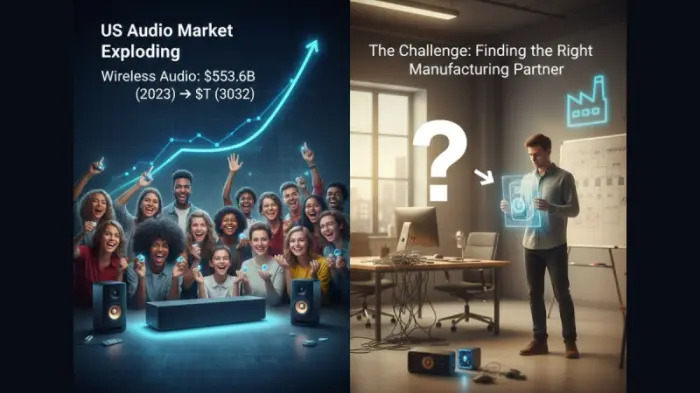
The U.S. audio market is exploding. Wireless audio alone is expected to jump from $553.6 billion in 2023 to over $2 trillion by 2032. But here's the catch—turning your brilliant product idea into something customers can actually buy is harder than most people think. Your biggest decision? Picking the right manufacturing partner.
Finding a manufacturer thousands of miles away who gets your quality standards, knows how to handle tricky supply chains, and understands what American customers want—that's the real challenge. Get this wrong, and your product joins the graveyard of failed launches.
This guide gives US brands a practical framework for choosing the right audio manufacturer. We'll walk through technical capabilities, quality control, logistics, and intellectual property protection. Your goal isn't just getting your product made—it's making sure it succeeds.
Understanding Today's Audio Manufacturing Reality
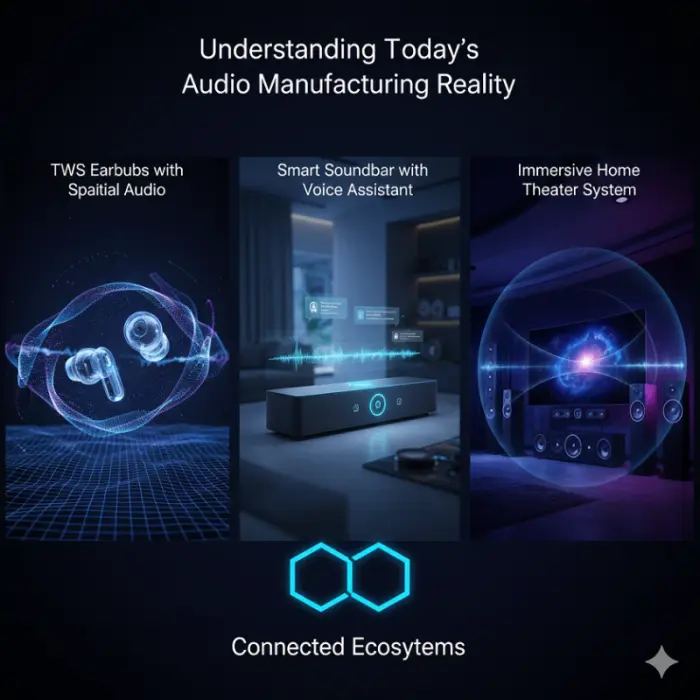
Audio manufacturing has changed completely. We're not talking about basic speakers anymore. Today's products are connected ecosystems: TWS earbuds with spatial audio, smart soundbars with voice assistants, immersive home theater systems. Your manufacturing partner needs to handle these advanced technologies without breaking a sweat.
OEM vs. ODM vs. JDM: Which Partnership Model Works for You?
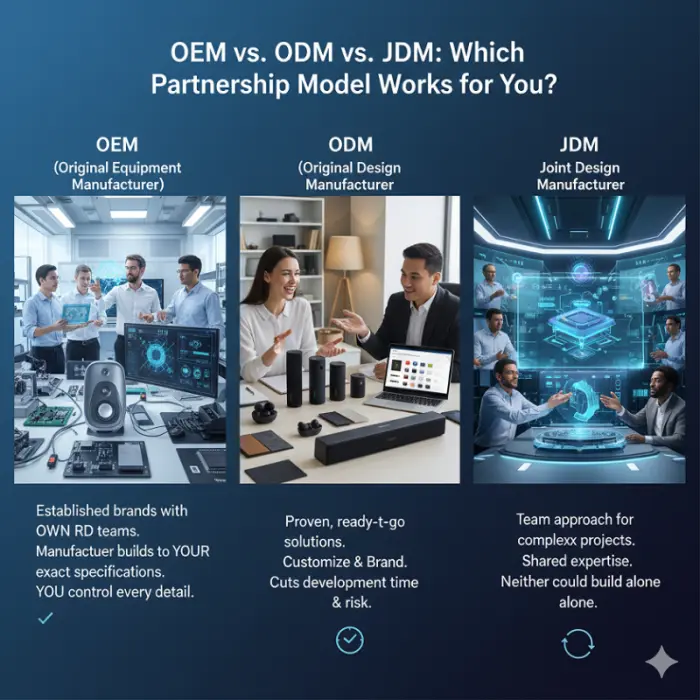
OEM (Original Equipment Manufacturer): Perfect for established brands with their own R&D teams and complete product designs. Your manufacturer builds exactly what you specify. You control every detail.
ODM (Original Design Manufacturer): Great for brands wanting proven, ready-to-go solutions they can customize and brand. This cuts development time and risk while keeping quality high.
JDM (Joint Design Manufacturer): A team approach for complex projects needing shared expertise. Your engineers work directly with theirs to create solutions neither could build alone.
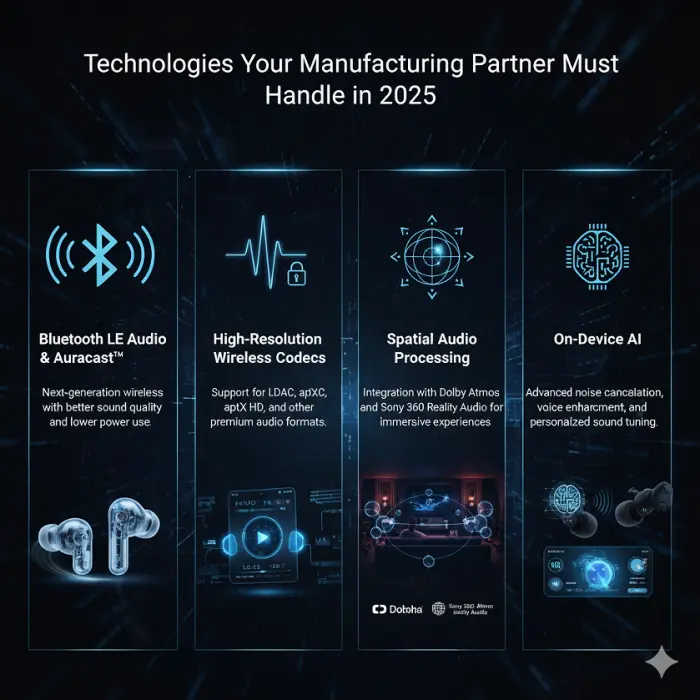
Technologies Your Manufacturing Partner Must Handle in 2025
Your chosen audio manufacturer needs to master the technologies driving the industry:
• Bluetooth LE Audio & Auracast™: Next-generation wireless with better sound quality and lower power use
• High-Resolution Wireless Codecs: Support for LDAC, aptX HD, and other premium audio formats
• Spatial Audio Processing: Integration with Dolby Atmos and Sony 360 Reality Audio for immersive experiences
• On-Device AI: Advanced noise cancellation, voice enhancement, and personalized sound tuning
The Non-Negotiable Checklist: 5 Must-Have Qualities in Your Audio Manufacturer
Quality 1: Engineering and R&D That Goes Beyond Assembly
Great custom speaker manufacturers don't just put parts together—they optimize your entire design. Look for partners offering:
• Design for Manufacturability (DFM) Analysis: Spotting potential production problems before they cost you money
• Acoustic Simulation and Tuning: Using anechoic chambers and advanced modeling to perfect sound signatures
• Component Selection Optimization: Balancing better performance with reasonable costs
• Built-in Regulatory Compliance: Making sure designs meet FCC, UL, and other US requirements from day one
Quality 2: A Clear and Proven Manufacturing Process
Knowing your manufacturer's process builds confidence and helps you plan better:
1.Prototyping & "Golden Sample" Approval: Refining until your exact specifications are met
2.Tooling & Molding: Precision manufacturing of custom components and enclosures
3.SMT (Surface-Mount Technology): High-precision PCB assembly with automated quality checks
4.Final Assembly: Skilled technicians combining all components with careful attention to detail
5.Multi-Stage Testing: Complete quality verification before shipping
Quality 3: Rock-Solid Quality Control for Picky US Customers
American consumers expect perfection. Your OEM audio solutions partner should use:
• IQC (Incoming Quality Control): Checking all components before production starts
• IPQC (In-Process Quality Control): Constant monitoring during manufacturing
• FQC (Final Quality Control): Complete testing of finished products
• OQC (Outgoing Quality Control): Final verification before US shipping
Make sure they know crucial US compliance standards: FCC electromagnetic compatibility, UL safety certifications, and CEC energy efficiency requirements.
Quality 4: Supply Chain Strength and Smart Component Sourcing
Recent chip shortages and shipping delays showed how critical supply chain management is. Top manufacturers handle this through:
• Multiple Supplier Networks: Backup sources for critical components
• Smart Inventory Management: Strategic stockpiling of essential parts
• Real-Time Supply Chain Visibility: Advanced tracking and forecasting systems
• Risk Planning: Ready responses to potential disruptions
Quality 5: Scalability – A Partner Who Grows With Your Brand
Your audio manufacturing process partner should handle everything from initial prototypes to mass-market volumes. This requires:
• Flexible Production Lines: Handling both small batches and high-volume runs
• Automated Quality Systems: Keeping consistency across all production scales
• Experienced Workers: Skilled technicians capable of complex assembly work
• Modern Infrastructure: Up-to-date facilities ready for future growth
Bridging the Pacific: What US Brands Need from Overseas Partners
Clear Communication: Beating Time Zones and Language Issues
Successful partnerships need more than emails and video calls. Look for manufacturers providing:
• Dedicated English-Speaking Project Managers: Your on-ground representatives who understand American business culture
• Regular Project Updates: Consistent communication so you're never left wondering
• Cultural Understanding: Partners who get both technical requirements and market expectations
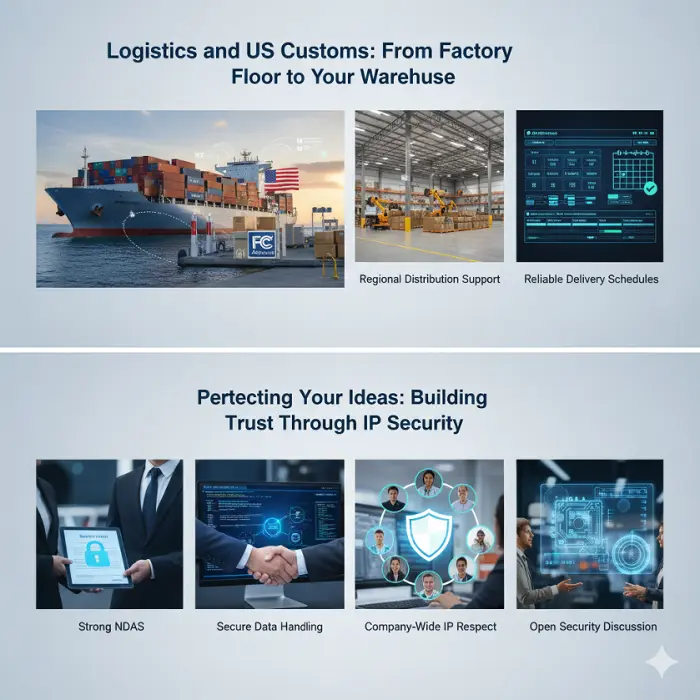
Logistics and US Customs: From Factory Floor to Your Warehouse
Expert high-fidelity audio production means nothing if products can't reach American customers efficiently. Your manufacturing partner should offer:
• International Freight Expertise: Optimized shipping routes and carrier relationships
• US Customs Clearance: Smooth handling of import duties and regulatory requirements
• Regional Distribution Support: Strategic partnerships with US-based logistics providers
• Reliable Delivery Schedules: Timelines you can count on for your business
Protecting Your Ideas: Building Trust Through IP Security
IP protection concerns are real and need direct answers. Good manufacturers use:
• Strong NDAs: Legal frameworks protecting all shared information
• Secure Data Handling: Encrypted communications and restricted access protocols
• Company-Wide IP Respect: Everyone understands that client innovations are off-limits
• Open Security Discussion: Clear explanation of protection methods
Real-World Examples: Concept to Customer
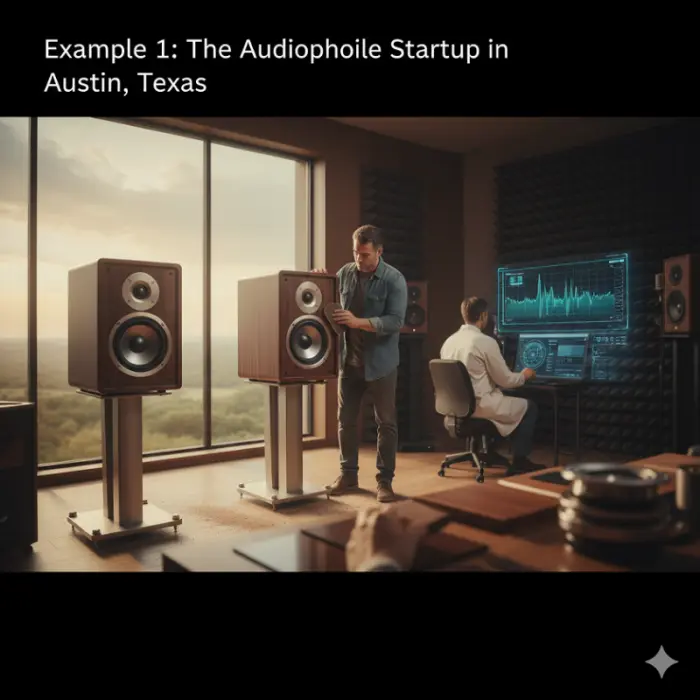
Example 1: The Audiophile Startup in Austin, Texas
Challenge: A boutique brand needs 500 units of a high-end bookshelf speaker for music lovers willing to pay premium prices.
Solution: The manufacturer sources exotic wood veneers from sustainable suppliers, integrates custom-designed drivers with specific frequency response curves, and uses master craftsmen for hand-finished details. Acoustic tuning happens in a certified anechoic chamber, making sure each unit meets the high standards audiophiles demand.
Example 2: The Fitness Tech Brand in Silicon Valley
Challenge: A health-focused company needs 10,000 custom TWS earbuds with biometric sensors, IPX7 water resistance, and 12-hour battery life for serious athletes.
Solution: The manufacturer tackles size challenges while keeping strong Bluetooth connectivity. Special attention goes to achieving IPX7 certification through advanced sealing techniques and smart component selection. Integrated heart rate and motion sensors need precise calibration, while custom battery management systems optimize power use.
Example 3: The Home Entertainment Brand in Miami
Challenge: A smart home company wants to launch a Dolby Atmos-enabled soundbar with voice control and wireless surround capabilities for the US Hispanic market.
Solution: The manufacturing involves complex software/hardware integration, managing multi-channel amplification across 11 drivers, and navigating official Dolby certification requirements. Additional work includes Spanish language voice recognition optimization and FCC Part 15 compliance for wireless connectivity.
Why Choose Jingyi Audio as Your Manufacturing Partner
At Jingyi Audio, we've built our 30+ year reputation on these exact principles. Located in Ningbo with direct port access, we combine decades of audio expertise with modern manufacturing capabilities designed specifically for American brands.
Our 15,000 square meter facility houses dedicated engineering teams, precision machining capabilities, and advanced testing laboratories. We specialize in OFC 99.99% copper conductors, ultra-low noise shielded cables, and precision machined connectors that meet the tough standards of the US professional audio market.
Ready to turn your audio vision into reality? Contact our US solutions team today for a confidential project consultation and see how we can bridge the gap to manufacturing success.
Frequently Asked Questions for US Brands
Q: What's a realistic Minimum Order Quantity (MOQ) for a custom speaker project?
A: MOQs vary by complexity, but typically range from 500-1,000 units for custom designs. We offer flexible arrangements for proven partners, including smaller pilot runs to test market response before full-scale production.
Q: How long from finalized design to first production run shipping to the US?
A: For new custom products, expect 12-16 weeks including tooling, sampling, and approval cycles. Existing ODM designs can ship within 6-8 weeks. Rush orders are possible with premium scheduling.
Q: How do you guarantee mass-produced units match the approved "golden sample"?
A: We use a complete quality management system including statistical process control, automated testing protocols, and batch sampling verification. Every production run includes random quality audits comparing against the golden sample specifications.
Q: What factors most influence the final unit cost of audio products?
A: Primary cost drivers include component specifications (drivers, amplifiers, processors), enclosure materials and finishing, order volume, and certification requirements. We provide detailed cost breakdowns during quotes for complete transparency.
Q: Can you help with US retail-ready packaging design and compliance?
A: Absolutely. Our packaging team understands US retail requirements including UPC barcodes, safety warnings, FCC compliance labels, and sustainable packaging trends. We can design everything from premium unboxing experiences to cost-effective mass retail packaging.