Leave Your Message
Choosing the China best Bulk Cable supplier for global buyers requires more than comparing prices. A reliable supplier should combine stable production, verified materials, clear documentation, and responsive communication. Copper purity, insulation thickness, conductor flexibility, and jacket durability can affect performance long after delivery. Small details matter.
Dr. George J. Anders, a respected power-cable specialist and author of Rating of Electric Power Cables in Unfavorable Thermal Environment, offers a practical reminder: “Cable selection must reflect the installation environment, not only the catalogue rating.” This principle applies to every Bulk Cable purchase. A cable designed for indoor control panels may fail in direct sunlight, wet soil, heavy vibration, or extreme temperatures. Buyers should examine test reports, operating conditions, voltage requirements, packaging methods, and batch consistency before approving large quantities.
China has many capable cable manufacturers. Not every factory offers the same level of control. Experienced buyers often request samples, audit production records, and confirm certification details with independent laboratories. They also study how suppliers manage copper sourcing, extrusion, stranding, and final inspection. A neat product photo proves very little.
The strongest supplier is not always the cheapest. It is the one that can explain its process clearly and accept reasonable technical questions. Still, no supplier is perfect. Communication gaps, delayed updates, or unclear specifications may appear during a large order. Buyers should leave room for verification and correction. This guide examines the practical standards, supplier signals, and purchasing questions that help global companies identify dependable Bulk Cable partners in China.
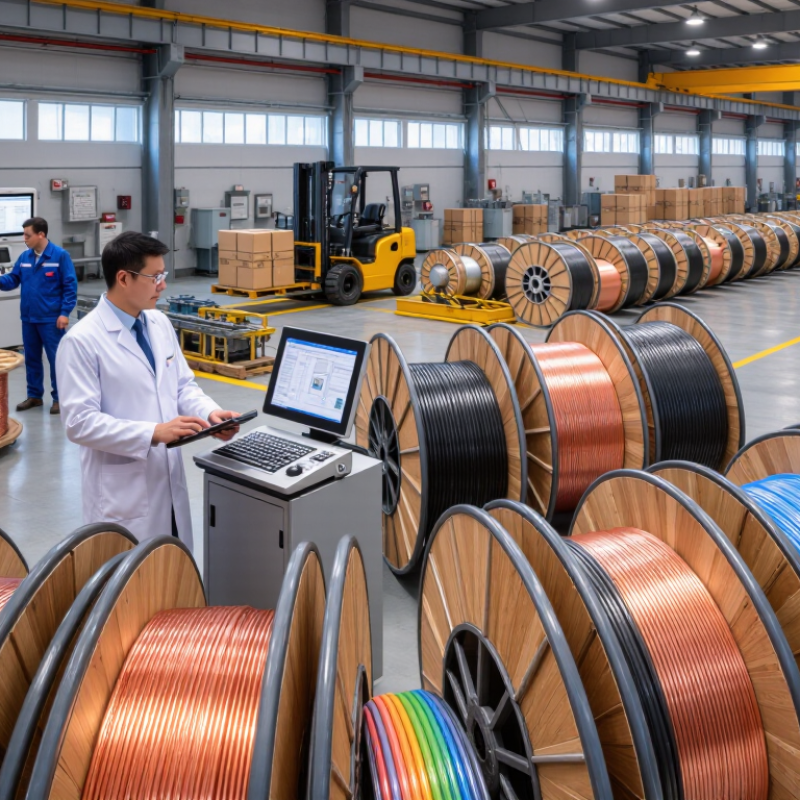
For global bulk buyers, cable selection begins with conductor class, not price. IEC 60228 defines Class 1 solid conductors, Class 2 stranded conductors, and Classes 5 and 6 for flexible applications. Class 2 usually suits fixed industrial wiring, while Class 5 handles repeated movement. Class 6 bends more easily, but it can increase cost and termination difficulty. Choose deliberately.
The 0.6/1 kV rating means U0 = 0.6 kV between conductor and earth, and U = 1 kV between conductors. IEC 60502-1 covers power cables for fixed installations within this voltage range. Its requirements address conductor resistance, insulation, sheath materials, and routine testing. The IEC 60228 conductor tables also specify maximum resistance values by size and class. For example, a 70 mm² copper Class 2 conductor has a lower resistance limit than a flexible equivalent only when construction and material controls remain consistent.
Demand is becoming less forgiving. The International Energy Agency’s Electricity 2024 report projected global electricity demand growth of about 4% in 2024. More distribution projects require traceable cable documentation. In practical purchasing, request conductor resistance records, insulation test results, dimensional reports, and batch identification. A certificate alone is not enough. I have seen specifications copied without checking installation conditions. That is a costly mistake. Bulk orders should also confirm bending radius, drum length, ambient temperature, and local approval requirements before production begins.
| IEC 60228 Conductor Class | Conductor Construction | Flexibility Level | Typical Bulk Cable Category | Common Insulation and Sheath Options | Typical Applications | 0.6/1 kV Suitability | Key Procurement Checks |
|---|---|---|---|---|---|---|---|
| Class 1 | Solid conductor made from a single wire. | Lowest flexibility; intended for fixed installations. | Fixed-installation building wire and power cable. | PVC, XLPE, or other insulation systems selected according to the applicable cable standard; sheath may be PVC, PE, or low-smoke compound. | Fixed wiring in buildings, panels, conduits, and equipment where repeated movement is not required. | Confirm conductor cross-sectional area, DC resistance, insulation material, flame performance, and installation temperature range. | |
| Class 2 | Stranded conductor made from multiple wires, designed for non-flexible installations. | More flexible than solid conductors, but not intended for continuous flexing. | Low-voltage power cable, control cable, and distribution cable. | Common combinations include XLPE insulation with PVC or low-smoke halogen-free sheath, depending on the design specification. | Industrial distribution, infrastructure, commercial buildings, cable trays, ducts, and fixed outdoor installations. | Check conductor compactness, screen or armour requirements, bending radius, environmental conditions, and local certification needs. | |
| Class 5 | Finely stranded conductor made from many small wires. | Flexible; suitable for equipment wiring and installations requiring easier routing. | Flexible power cable, welding cable, equipment cable, and portable supply cable. | PVC, rubber, thermoplastic elastomer, or other flexible insulation and sheath systems selected for the intended service. | Portable equipment, control cabinets, machinery connections, temporary power, and areas requiring frequent handling. | Verify repeated-flexing capability, minimum bending radius, oil or abrasion resistance, conductor resistance, and termination compatibility. | |
| Class 6 | Extra-finely stranded conductor made from smaller wires than Class 5. | Highest flexibility among the IEC 60228 conductor classes. | Extra-flexible power cable, robotics cable, drag-chain cable, and specialized equipment cable. | Flexible PVC, PUR, rubber, or other application-specific insulation and sheath materials. | Robotic systems, moving machinery, drag chains, industrial automation, and applications with frequent movement. | Confirm flex-cycle performance, torsion resistance, travel speed, acceleration, temperature range, and the manufacturer’s tested installation conditions. | |
| Armoured 0.6/1 kV Cable | Usually uses a Class 2 stranded conductor; other conductor classes may be specified for particular designs. | Generally intended for fixed installation; armour improves mechanical protection. | Steel wire armoured or other mechanically protected low-voltage power cable. | Common constructions include XLPE insulation, metallic armour, and PVC or low-smoke halogen-free oversheath. | Direct burial, outdoor distribution, industrial plants, cable trenches, and areas exposed to mechanical impact. | Specify armour material, fault-current capability, gland type, corrosion protection, burial conditions, and earthing arrangement. | |
| Unarmoured 0.6/1 kV Cable | Commonly uses a Class 2 stranded conductor; Class 1, 5, or 6 may be selected according to the application. | Flexibility depends on the conductor class and cable construction. | Building power cable, industrial cable, solar balance-of-system cable, and distribution cable. | Typical options include XLPE/PVC, PVC/PVC, or low-smoke halogen-free constructions. | Cable trays, conduits, plant rooms, switchboards, commercial buildings, and protected outdoor routes. | Review installation method, current-carrying capacity, voltage drop, short-circuit rating, fire performance, and sunlight or moisture exposure. |
Technical reference: IEC 60228 defines conductor classes and conductor resistance requirements, while 0.6/1 kV identifies the rated voltage designation U0/U. The complete cable must be selected against the applicable product standard, installation method, environmental conditions, and required testing or certification.